


6 Common Mistakes to Avoid in the MCA Exam
Key Takeaways ➤The MCA exam requires consistent practice and clarity of concepts. ➤Avoid skipping syllabus analysis and poor planning. ➤Leverage SRM Sikkim’s 100% Online learning for flexibility. ➤Access expert guidance, Live + Recorded Classes, and Placement Assistance. ➤Earn a World-Class Education through an AICTE-Approved, NAAC A+ Accredited, UGC-Entitled Program. Preparing for the MCA exam can be overwhelming, especially when students overlook simple yet vital steps. At SRM University Sikkim, we help learners pursue a world-class education through our 100% Online, UGC-entitled program, ensuring a Globally Recognized Degree with expert guidance. What is the MCA Exam and Why is it Important? The MCA exam evaluates a student’s ability to apply programming, logical reasoning, and analytical skills. Even though you pursue it through the MCA online admission or direct MCA admission, this examination builds the foundation for advanced computing roles. 6 Common Mistakes to Avoid in the MCA Exam 1. Poor Time Management Many students study hard but still struggle in the MCA Exam because they do not manage their time well. They spend too long on one question and rush through the rest. This leads to silly errors. Practice timed mock tests so you know how much time to give each section. 2. Ignoring the Syllabus Some students prepare random topics without checking the official syllabus. This wastes effort and leaves gaps in key areas. Before you start, download the syllabus and stick to it. The MCA Exam is always based on specific topics, so following the syllabus saves time and boosts accuracy. 3. Not Practicing Practical Questions The MCA program is technical, so the MCA Exam often includes problem-solving and logic-based questions. Students who only read theory struggle in such sections. Spend time solving coding basics, reasoning, and math practice questions regularly. 4. Overlooking Previous Year Papers Previous year papers show the real pattern of the MCA Exam. Many students skip them and lose the chance to learn repeated topics and common question styles. Solving old papers also improves speed and confidence. 5. Weak Understanding of Concepts Rote learning does not help in the MCA Exam. If your base is weak, even easy questions can feel confusing. Focus on understanding topics like data structures, basic programming, math logic, and computer fundamentals. Clear concepts reduce panic during the exam. 6. Not Revising Properly Students often study many topics but forget them because they do not revise. Revision is what locks the knowledge in your mind. Even a short daily revision plan makes a big difference. Go back to formulas and key notes before the MCA Exam, especially in the last two weeks. What Should You Know Before Taking the MCA Exam? Before enrolling, ensure you meet the MCA admission eligibility criteria. SRM Sikkim’s MCA is a UGC-Entitled Program offering a Globally Recognized Degree, supported by expert mentorship and Placement Assistance. How Can You Create an Effective Study Plan for the MCA Exam? List key topics from the official syllabus. Divide your time into theory, coding, and revision sessions. Take periodic self-tests. Use SRM’s Interactive Online Platform to access materials anywhere, a true Global Access advantage. Conclusion Choosing SRM Sikkim for your MCA exam journey ensures you receive a world-class education through a 100% Online, Industry-Aligned Curriculum, guided by Subject Matter Experts. With Affordable Fees, No Relocation Needed, and Global Access, SRM Sikkim stands as a trusted choice for your career growth. Want to explore this topic further? ” Top MCA Certifications to Advance Your IT Career in 2025 ” for more insights. FAQs Can You Do MCA Without CET?Yes, SRM Sikkim allows MCA admission directly based on eligibility criteria, without requiring CET. Can You Do Both an MBA and an MCA?You can pursue one after the other. Many students complete an MCA first, then an MBA to expand managerial skills. Is MCA a Government Job?MCA is not a job; it’s a professional degree. However, it opens pathways to government and private IT roles. Which MCA Job Has the Highest Salary?Software Developers, Data Analysts, and IT Managers earn among the highest packages after completing the MCA.
5 Essential Steps in the BCA Admission Process
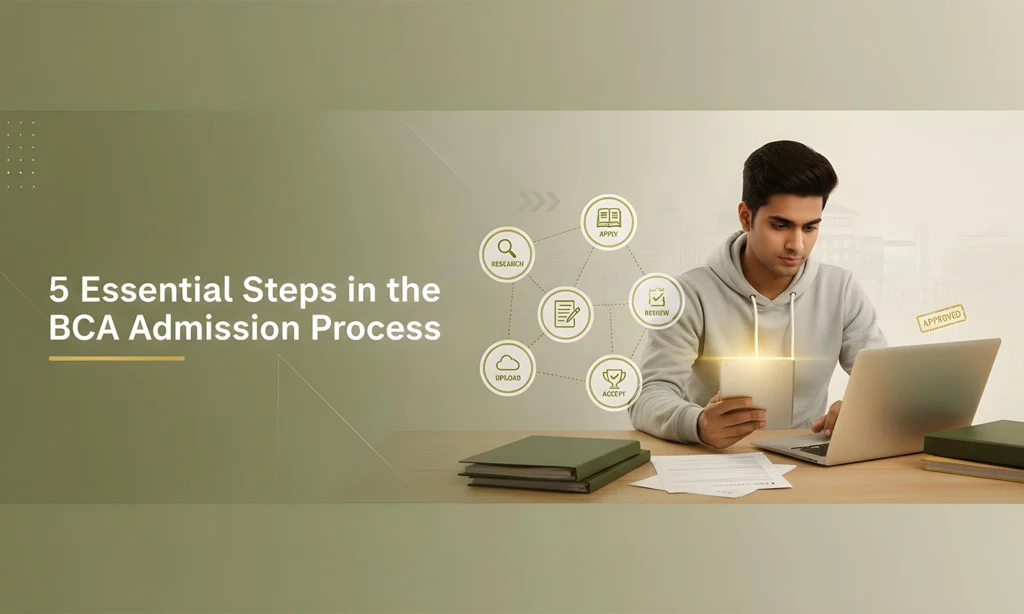
Overview The BCA admission process generally involves checking eligibility, selecting a suitable program, completing the application and submitting the required documents. Students should understand the BCA admission requirements before applying so they can prepare their academic records and complete each stage correctly. Knowing the process in advance can make BCA course admission more organised and easier to manage. What Is the BCA Admission Process Like? The BCA admission process at SRM Online is designed to make higher education accessible, flexible, and career-oriented for aspiring IT professionals. Through a 100% online platform, students can apply, upload documents, and complete registration without any physical visits or paperwork. The process ensures that learners from diverse academic backgrounds can smoothly begin their journey toward a globally recognized degree.The online MBA admission process is seamless. Students can apply through SRM’s interactive online platform, upload required documents, and receive guidance from subject matter experts for smooth onboarding.For students planning their BCA admission, understanding each stage before beginning the application can help them avoid common mistakes. The process usually starts with checking eligibility and continues through application submission, document verification and confirmation of admission. The exact procedure can vary depending on the institution and program. Students should also check the current admission guidelines before applying. This helps them understand the qualifications, subject requirements, documents and other conditions applicable to the program. 5 Essential Steps in the BCA Admission Process 1. Check Eligibility Criteria The first step is to understand the BCA eligibility criteria. To enroll in SRM’s online program, students must have passed their 10+2 examination (any stream) from a recognized board with mathematics as a core or additional subject. This ensures a strong foundation in logical reasoning, programming, and computing skills that are critical in today’s digital world.Understanding the eligibility for BCA after 12th helps you prepare early and gather the necessary documents for a smooth admission process.Eligibility is the foundation of any BCA course admission application. Students should confirm that their Class 12 qualification, stream and subject background meet the requirements specified by the institution. Applicants should also check if there are any minimum marks or additional academic conditions. Reviewing these details before completing the application can help students determine if they are ready to proceed with the admission process. 2. Choose the Right Admission Path Once eligibility is confirmed, the next step is to choose your admission mode. At SRM Online, students can apply directly through the interactive online platform. The system allows for complete digital enrollment, right from filling out the application form to paying fees online. This no-relocation-needed approach provides flexibility for students balancing studies with personal or professional commitments.The application stage is an important part of the BCA admission process. Students should use the official application platform and carefully enter their personal and academic information. While completing the BCA application form, applicants should ensure that names, dates of birth, contact details and educational information match their official documents. Carefully reviewing the form before submission can reduce the possibility of errors during verification. 3. Research and Apply to Colleges Before submitting your application, it’s important to research institutions offering world-class education and industry relevance. SRM Online stands apart with its UGC-Entitled, AICTE-Approved, NAAC A+ Accredited status. The eligibility for the BCA course is uniform across India, but SRM’s commitment to global access and affordable fees gives students the additional advantage of recognized certification and real-world learning outcomes.Students comparing options for BCA admission should look at more than the course name. The learning format, curriculum, academic support, fee structure and career services can all influence the overall learning experience. It is also useful to understand the program duration and delivery format before submitting an application. Students choosing online education should check how classes, assessments, study materials and student support are provided. Once an institution has been selected, applicants can proceed with the BCA application form and follow the university’s instructions for completing enrollment. 4. Appear for the Entrance Exam While some universities conduct entrance tests, SRM Online offers a simplified BCA admission process that prioritizes academic merit and eligibility over entrance exam scores. This helps students focus on demonstrating their true BCA qualification and readiness for a professional IT career, without unnecessary exam-related stress.Entrance exam requirements are not the same across all BCA programs. Some institutions may have an entrance test while others may base admission on academic qualifications. Students should therefore confirm the admission method of their chosen university rather than assuming that an entrance examination is required for every BCA program. Understanding this requirement in advance can help applicants prepare the right documents and complete the BCA admission requirements without missing an important stage. 5. Confirm Admission An MBA without an entrance exam ensures students can enroll in 100% online programs with live + recorded classes, flexible learning schedules, and no relocation needed. This is ideal for working professionals aiming to balance education with their job.Once the application and document verification stages are completed, students need to follow the institution’s instructions to confirm their admission. This may include completing the required fee payment and other enrollment formalities. Applicants should retain their payment confirmation, admission communication and submitted documents for their records. The university will provide information about the next steps after admission is confirmed. For students completing an online BCA course admission, confirmation may also include instructions about accessing the learning platform, classes and other academic resources. What Are the Documents Required for BCA Admission? Before applying, keep the following documents ready to ensure a smooth application process: ➤Class 10 and 12 mark sheets and certificates ➤Transfer or migration certificate ➤Government ID proof (Aadhaar, Passport, or PAN) ➤ Passport-size photo and scanned signature These documents confirm your BCA eligibility criteria and academic background. Uploading accurate details helps expedite verification during the BCA in the SRM admission process.These are some of the commonly requested BCA admission documents, although the exact list may differ by institution. Students should refer to the university’s official checklist to confirm what needs to be submitted. Applicants
AI Courses After 12th: Kickstart Your Journey Before Joining BCA
Why Learn AI After 12th? Choosing AI courses after 12th gives students a strong head start in the world of technology. With automation and analytics shaping every industry, understanding AI and ML courses early can enhance critical thinking and problem-solving skills. SRM’s UGC-Entitled, AICTE-Approved programs prepare students to master intelligent systems even before they enter college.Learning AI helps you build a future-ready mindset, ensuring that when you pursue your BCA, you already have the fundamentals of data handling, algorithms, and real-world applications. What Role Does AI Play in the BCA Curriculum? AI is becoming a core part of the modern BCA curriculum, where subjects like machine learning, data analytics, and AI programming are integrated into projects and assessments. With SRM’s industry-aligned curriculum, students don’t just study theory; they engage in live coding sessions, interactive case studies, and real-world projects guided by subject matter experts.These sessions help students learn AI practically, using the same tools professionals use in the tech industry. Top AI Courses to Take After 12th Before Joining BCA If you’re planning to pursue AI courses after 12th, here are some beginner-friendly options that can help you before entering college: Introduction to Artificial Intelligence – Ideal for students wanting to understand the basics of AI and its applications. AI Courses Online – Self-paced learning through SRM’s interactive online platform, offering hands-on experience. Learn AI Programming – Focuses on Python, TensorFlow, and real-life data simulation for better conceptual learning. AI and ML Courses – Perfect for those who want to explore machine learning before beginning their BCA in AI journey. AI Classes – Short-term live sessions designed to provide personalized mentorship and feedback. SRM also provides affordable fees and EMI options available, ensuring students can start learning AI early without financial strain. What Are the Skills Gained from Taking AI in BCA? Pursuing AI courses after 12th and integrating them with your BCA in Artificial Intelligence program helps you develop: ➤Analytical and logical reasoning skills ➤AI-based problem-solving capabilities ➤Knowledge of algorithms and predictive modeling ➤Hands-on experience with tools like TensorFlow and Python ➤Strong foundations for a master’s in AI or data science Through SRM’s live + recorded classes, you can gain these skills with the flexibility to learn anytime, anywhere, no relocation needed. Conclusion Starting AI courses after 12th gives students a competitive edge before joining BCA. With SRM’s globally recognized degree, industry-aligned curriculum, and placement assistance, learners can build a powerful foundation in technology, preparing for advanced roles in the digital world. FAQs Is AI Difficult to Study?AI can seem complex, but with structured AI classes and expert guidance, students can easily grasp the fundamentals. Is AI a Good Future Career?Yes, AI offers global opportunities and is among the most in-demand tech careers, especially for those pursuing AI courses after 12th. What Is the Cost of an AI Course?The fees depend on duration and depth. SRM offers affordable online courses with flexible payment and EMI options available.
BCA Required Maths: Syllabus, Topics, and Study Plan 2026
Overview The BCA required maths syllabus typically covers algebra, statistics, probability, calculus, matrices and discrete mathematics. These concepts support programming, logical reasoning and data-related subjects. Students without a strong mathematics background can prepare through regular practice, foundational study materials and bridge courses offered by some universities. Key Takeaways ➤BCA Required Maths includes algebra, probability, calculus, and discrete mathematics. ➤Students often ask: “Can I get admission in BCA without Maths?” The answer is yes, in some universities with bridge courses. ➤Using standard textbooks and digital resources included in BCA admission fees can improve preparation. ➤A clear study plan makes BCA without maths background manageable. ➤Focusing on the BCA eligibility criteria after 12th ensures you meet requirements before applying. Introduction Many students planning to study BCA often ask if the BCA-required maths is compulsory. While not all universities demand strong math skills, a basic understanding of mathematics helps during the course. For those worried about BCA eligibility, it’s important to know that some universities allow BCA without maths, while others require students to take a bridge course. If you meet the BCA eligibility criteria after 12th and want to succeed in maths-based BCA subjects, proper preparation is key.For students comparing degree options, it also helps to understand why mathematics appears in a computer applications programme. The subject is not limited to calculations. Concepts such as logic, probability, functions and matrices can support areas such as programming, algorithms, data analysis and computer science fundamentals. The demand for computer-related education also continues to remain significant in India. According to the Ministry of Education’s AISHE 2021-22 data, 622,697 students were enrolled in the Bachelor of Computer Applications programme across the reported institutions. This makes understanding the academic requirements of BCA useful before choosing a programme. What is the Syllabus in Online BCA? The online BCA program generally covers computer programming, database management, software development, and networking. Alongside these, mathematics is introduced to strengthen problem-solving and logical skills. Universities like Online SRM often add bridge courses for students who ask, “Can I get admission in BCA without Maths?” This ensures everyone can handle subjects like algorithms and statistics, even if they did not study advanced maths in school.The exact mathematics syllabus can differ across universities and programme structures. Students should therefore check the curriculum before admission instead of assuming that every BCA programme has identical subjects. In most cases, the BCA subjects combine technical concepts with supporting subjects that develop analytical and problem-solving abilities. For students considering online BCA admission, checking the curriculum in advance can also make preparation easier. It allows you to identify areas where you may need additional practice before classes begin. This is particularly useful for students who studied commerce, biology or another stream in Class 12 and are concerned about mathematics. What Topics Are Covered in BCA with Maths? The BCA with the maths section usually includes: ➤Algebra (sets, relations, functions) ➤Probability and statistics ➤Matrices and determinants ➤Differential and integral calculus ➤Discrete mathematics (logic, Boolean algebra) ➤Numerical methods These areas support BCA subjects like programming, data analysis, and database management. Students preparing for the BCA qualification should revise these topics to ensure a smooth learning experience.The BCA required maths syllabus can therefore be viewed as a support system for several technical concepts rather than as an isolated subject. For example, functions can help students understand relationships between inputs and outputs, while discrete mathematics introduces logical structures that are useful when working with algorithms and programming. Students do not necessarily need to begin with advanced problems. A better approach is to revise school-level concepts first and then gradually move towards topics included in the university curriculum. Building this foundation can make the BCA subjects that involve logic and analytical thinking easier to understand. What are the Best Textbooks and Study Materials for BCA Maths Preparation? To prepare effectively, students can use standard textbooks and online resources. Books like Discrete Mathematics by Rosen, Engineering Mathematics by B.S. Grewal, and Probability and Statistics by Gupta and Kapoor are excellent references. Online tutorials, video lectures, and practice assignments from the university portal also help. Since Online BCA admission fees already cover access to digital resources, students should take full advantage of these study materials.Students who are concerned about the BCA required maths can also create a simple resource plan instead of relying on several books at once. One textbook can be used for concepts, while practice questions can be used to test understanding. Short video lessons can help when a particular formula or concept is difficult to understand. It is also useful to maintain a notebook containing important formulas, definitions and solved examples. Revisiting this material regularly can reduce the amount of revision required before examinations. How Should You Create an Effective Study Plan for the BCA Maths Exam? Creating a strong study plan is essential for passing the BCA required maths exam. Start by dividing topics into weekly goals and practicing problems daily. Use mock tests to check your speed and accuracy. Dedicate more time to weak areas like calculus or probability. Group discussions and online forums can also clarify doubts. With consistent practice, even non-maths students can master the basics required in the BCA maths syllabus.A practical study plan should begin with the topics that form the foundation for other concepts. Students can spend the first stage revising algebra, functions and basic statistics before moving to calculus, matrices or discrete mathematics. The second stage can focus on solving questions rather than simply reading theory. For students pursuing BCA without maths, an additional revision period can be useful. The goal should be to understand how mathematical concepts are applied rather than memorising every formula without context. Solving a small number of questions consistently can be more useful than attempting a large set of problems only before an examination. Students asking whether I can get admission in BCA without maths should also remember that admission eligibility and academic preparation are two different questions. A university may permit admission through its stated eligibility route, but students
Step Into the Future: How an Online MCA Shapes the Next Generation of Tech Leaders

Key Takeaways ➤Online MCA programs prepare students with advanced technical and leadership skills. ➤The online MCA benefits include flexibility, strong career outcomes, and industry relevance. ➤Online MCA for working professionals allows upskilling without career breaks. ➤Choosing the right online MCA specialization ensures future-proof skills in AI, cloud, and cybersecurity. Introduction The world runs on code. Every industry, from finance and healthcare to retail and government, depends on technology to function, innovate, and grow. To meet this demand, professionals need advanced skills that combine deep technical expertise with leadership abilities. That is where an online MCA stands out. At Online SRM, the MCA program is designed not just to teach computer applications but to prepare students to become leaders in IT. With specializations in areas such as AI, cloud computing, and cybersecurity, the program represents a true investment in the future of technology and professional growth. 1. Why an Online MCA Matters in Today’s Tech World? The demand for skilled IT professionals has never been higher. Recruiters are actively searching for graduates who are not only technically capable but also adaptable to emerging technologies. An online MCA program ensures students gain both.The online MCA benefits include staying ahead in areas such as artificial intelligence, machine learning, and cloud solutions. With the right online MCA specialization, students are positioned to contribute meaningfully to the evolving tech ecosystem. 2. How Flexibility Helps Working Professionals Upskill Without Career Interruptions? Balancing a full-time career with higher education can feel overwhelming, but an online MCA for working professionals eliminates that barrier. Flexible schedules, virtual classrooms, and Coursera-integrated content allow learners to study at their own pace without sacrificing their careers.This flexibility highlights one of the biggest online MCA benefits. Students can upskill while continuing to earn, ensuring both immediate and long-term returns. Professionals do not have to pause their careers to build expertise in high-demand technologies. 3. Key Technical Skills Gained from an Online MCA An online MCA program is much more than a theory-driven curriculum. Students gain practical skills in programming, database management, system design, and advanced computing. Through online MCA specializations, learners can focus on AI, cloud computing, or cybersecurity, areas where demand continues to outpace supply. These technical capabilities prepare graduates for high-growth roles such as data scientists, cloud architects, ethical hackers, and system analysts. The versatility of skills gained through an online MCA makes it one of the most future-ready qualifications in technology. 4. Career Outcomes: How an Online MCA Propels Tech Careers? One of the strongest online MCA benefits lies in the career outcomes it enables. Graduates often move into roles with higher responsibility, better salaries, and greater impact. Recruiters increasingly prefer candidates who combine real-world work experience with advanced academic credentials. For working professionals, an online MCA specialization can be the differentiator that sets them apart in a competitive job market. It demonstrates commitment to growth, adaptability to new tools, and readiness for leadership positions. 5. Building Leadership: Soft Skills and Networking in Online MCA Technical mastery is essential, but leadership requires more. An online MCA program ensures that students also build soft skills such as problem-solving, critical thinking, and effective communication. These are reinforced through online collaborations, group projects, and industry-focused case studies.Another overlooked benefit of an online MCA for working professionals is the networking opportunity. Students connect with peers, faculty, and industry experts across geographies, creating networks that prove valuable throughout their careers. Combining hard skills with leadership development ensures graduates are prepared not just to work in technology but to lead it. FAQs What Are The Benefits Of An Online MCA? The key online MCA benefits are flexibility, specialization in high-demand fields, and strong career growth opportunities. Who Should Pursue An Online MCA? An online MCA for working professionals is ideal for those who want to continue earning while gaining advanced IT skills. What Specializations Are Available In An Online MCA? Popular online MCA specializations include artificial intelligence, cloud computing, and cybersecurity. How Does An Online MCA Help In Career Growth?An online MCA program improves technical expertise and leadership abilities, making graduates attractive to recruiters in top IT roles.
Step-by-Step Guide to MCA Admission Entrance Exam
Introduction The MCA admission entrance exam is a crucial step for students aspiring to pursue a Master of Computer Applications degree. Conducted at the state or national level, these exams test problem-solving, programming, and logical reasoning skills. Whether you are applying to a traditional campus program or considering MCA online admission, understanding the exam’s eligibility, syllabus, and preparation strategies is essential. This guide walks you through every step to help you succeed. What is the MCA Admission Entrance Exam and Why Is It Important? The MCA admission entrance exam evaluates a student’s readiness for postgraduate study in computer applications. Exams such as NIMCET, TANCET, and various state CETs are widely recognized. They assess mathematics, logical reasoning, and computer fundamentals to ensure candidates are prepared for advanced coursework. For those aiming at reputed universities, clearing the MCA entrance exam is often mandatory. What Are the Eligibility Criteria for the MCA Entrance Exam? To appear for the MCA admission entrance exam, students must meet certain requirements: ➤ Hold a bachelor’s degree (BCA, B.Sc. IT, or equivalent). ➤ Have studied Mathematics at 10+2 or undergraduate level. ➤ Maintain at least 50% aggregate marks in graduation (relaxation for reserved categories). These MCA eligibility criteria are part of the broader MCA admission eligibility requirements across universities. Always check specific rules before applying. What Topics Are Included in the MCA Entrance Exam Syllabus? The syllabus for the MCA admission entrance exam generally includes: ➤ Mathematics – algebra, calculus, probability, matrices, statistics. ➤ Computer Science – C programming, data structures, operating systems, DBMS. ➤ Logical Reasoning – coding-decoding, puzzles, analytical questions. Understanding this structure helps you focus on areas that carry higher weightage. Preparing early makes MCA admission much smoother. What Are the Best Study Materials and Resources to Prepare for the MCA Exam? Quality resources are key to cracking the MCA admission entrance exam. Standard references include Discrete Mathematics by Rosen, Data Structures by Seymour Lipschutz, and Operating Systems by Galvin. Students should also use online platforms that provide video lectures and mock tests. Universities like SRM, which offer transparent structures such as SRM MCA fees, also provide digital resources as part of their programs. This ensures students can prepare effectively while applying for MCA online admission. Conclusion Succeeding in the MCA admission entrance exam requires a clear understanding of eligibility, syllabus, and preparation resources. By building a strong foundation in mathematics, practicing programming, and using the right study materials, students can boost their chances of securing admission. Institutions like SRM, with affordable SRM MCA fees and online programs, offer students multiple pathways to achieve their MCA goals. Key Takeaways ➤ The MCA admission entrance exam tests mathematics, computer science, and reasoning. ➤ Students must meet MCA eligibility criteria such as a bachelor’s degree and 50% marks. ➤ Standard books and online platforms are the best tools for preparation. ➤ MCA online admission options are available for students not taking entrance exams. ➤ Transparent fee structures like SRM MCA fees make planning easier. FAQs Can You Join the MCA Without TANCET?Yes. While TANCET is one option, some universities allow MCA online admission without mandatory entrance exams. Admission is based on graduation scores and other requirements. Is MCA Better Than an MCA?This is often a misphrased question. MCA stands for MCA full form in education: Master of Computer Applications. The value depends on the institution. Choosing the best institute for MCA ensures better career opportunities. Which Branch of MCA Is Best?The choice depends on your career goals. Popular branches include Artificial Intelligence, Cybersecurity, and Data Science. Meeting the MCA admission eligibility ensures you can specialize in these areas.
How to Apply for BCA Lateral Entry Successfully

Overview BCA Lateral Entry allows eligible diploma holders to join a BCA program at an advanced stage instead of beginning from the first year. The route can be useful for students with prior education in Computer Science, IT or related areas. Understanding BCA lateral entry eligibility, admission requirements, documents and the application process can help students apply with greater clarity. Key Takeaways ➤BCA lateral entry allows diploma holders to join from the second year. ➤Students must meet BCA admission criteria like 50% marks in a diploma. ➤The requirement for BCA admission varies slightly by institution. ➤Documents such as diploma mark sheets and ID proof are essential. ➤This route saves time, reduces costs, and speeds up career opportunities. Introduction For students who already hold a diploma in computer applications or an equivalent qualification, the online BCA lateral entry eligibility route offers a faster way to complete their degree. Instead of starting from the first semester, lateral entry students usually join directly in the second year. Understanding the BCA Lateral Entry Admission process, its requirements, and who qualifies is essential before applying. This guide explains everything you need to know to make the application process smooth and successful.Students considering BCA lateral entry after diploma should first check the admission rules of the university they intend to join. The accepted diploma subjects, minimum marks, entry point and document requirements can differ between institutions. Checking these details before submitting an application can help avoid delays during admission. What is BCA Lateral Entry and How Does It Work? The BCA lateral entry option allows BCA diploma holders or students with prior computer-related education to enter the program at an advanced stage. BCA Duration of completing the standard three-year course, eligible students begin from the third semester and finish in just two years. This pathway is designed for students who already meet the BCA admission criteria and want to save time while still earning a full undergraduate degree in computer applications.The BCA lateral entry admission route is based on the recognition of a student’s previous academic preparation. Instead of repeating subjects or starting the degree from the first semester, eligible candidates may receive entry into a later stage of the program. The exact structure depends on the university’s academic regulations.For students looking for BCA second-year admission, it is important to confirm that the institution specifically provides a lateral entry pathway. Not every BCA program offers the same entry option, so applicants should verify the program structure before paying application or admission fees. Who is Eligible for BCA Lateral Entry Programs? Eligibility for BCA Degree Lateral Entry Admission generally follows specific rules: ➤Candidates must hold a diploma in Computer Science, IT, or related fields. ➤Some universities accept students with equivalent qualifications in software or hardware programs. ➤A minimum of 50% marks in the diploma is required to meet BCA admission eligibility. ➤The exact qualification for BCA admission may vary slightly depending on the institution. Meeting these conditions ensures that students have the necessary foundation to join directly in the second year.The BCA lateral entry eligibility criteria may also include specific requirements related to the type of diploma completed. A diploma in Computer Science, Information Technology or another related discipline may be considered depending on institutional rules. Students should therefore review the eligibility conditions carefully rather than assuming that every diploma will qualify. The BCA lateral entry for diploma holders route can be particularly relevant for students who have already studied programming, databases, computer fundamentals or related subjects during their diploma. Their previous academic background can provide a foundation for progressing into the degree at an advanced stage. What Are the Advantages of BCA Lateral Entry? Choosing the BCA lateral entry route comes with several benefits: ➤Time-Saving – Complete the degree in two years instead of three. ➤Cost-Effective – Since one year is skipped, the overall fee burden is reduced. ➤Career Acceleration – Students can move into jobs or higher studies like MCA sooner. ➤Skill Recognition – Prior learning from a diploma is valued and credited. These advantages make lateral entry a smart choice for students who meet the requirements for BCA admission in 2026 through earlier studies. Another advantage is continuity in learning. Students entering through BCA lateral entry after a diploma can build on subjects they have already studied instead of beginning their undergraduate education from the starting level. This can make the transition more relevant for students who already have an academic background in computing. However, students should consider more than just the shorter duration. They should check the curriculum, mode of learning, academic support, recognition of previous qualifications and progression opportunities before selecting a program. What Documents are Required for BCA Lateral Entry? When applying for BCA lateral entry, students typically need to submit: ➤ Diploma mark sheets and certificate. ➤ Class 10 and 12 mark sheets for record verification. ➤ Government-issued ID proof. ➤ Passport-size photographs. Submitting these documents ensures your application matches the BCA criteria set by the university. Most institutions provide a clear checklist along with the application form. For a BCA lateral entry admission process, students may also need to provide additional academic records depending on the institution. Applicants should keep scanned and physical copies of their certificates, mark sheets and identification documents ready when completing the application. It is also important to enter personal and academic details accurately. Any difference between the information in the application form and the submitted documents may require additional verification. How Does the BCA Lateral Entry Admission Process Work? The BCA lateral entry admission process generally begins with checking the university’s eligibility requirements. Students can then review the available program, understand the entry level and submit the application with the required academic and identity documents. A typical process may involve the following steps: ➤Check BCA lateral entry eligibility: Confirm that your diploma and marks meet the institution’s requirements. ➤Review the program details: Check the duration, curriculum, admission mode and entry semester. ➤Complete the application: Enter your personal, educational and contact details carefully. ➤Upload
5 Essential Tips for the MCA Admission Exam
Introduction The MCA admission exam is the gateway for students who want to pursue a Master of Computer Applications degree in India. Since MCA is a postgraduate program, aspirants must first meet the MCA admission eligibility requirements, such as having a bachelor’s degree and a background in mathematics. Understanding the exam pattern, syllabus, and preparation strategy is essential for success. In this guide, we’ll cover the key details of the exam and provide 5 practical tips to help you prepare effectively. What to Expect in the MCA Admission Exam? The MCA admission exam usually tests candidates on their logical reasoning, quantitative aptitude, and computer science fundamentals. Depending on the university or exam body, the structure may include sections on general mathematics, programming basics, and analytical ability. For instance, NIMCET and state CETs are common entry routes. Students applying for MCA online admission should still be familiar with these topics, even if their chosen university doesn’t mandate an entrance exam. What Is the Syllabus for the MCA Admission Exam? The syllabus of the MCA admission exam covers a mix of mathematics and computer science topics. Common areas include: Mathematics: algebra, probability, statistics, calculus, and discrete structures. Computer Science: data structures, operating systems, C programming, and DBMS. Logical Reasoning: puzzles, coding-decoding, and analytical questions. Students should also revise the MCA full form in education – Master of Computer Applications – to remind themselves that this is a professional degree requiring both conceptual and applied knowledge. What Are the 5 Essential Tips to Prepare for the MCA Admission Exam? 1. Understand the Exam Syllabus and PatternThe first step in preparing for the MCA admission exam is knowing the syllabus and structure. Review past exam papers to identify weightage across topics. Check your university’s website for detailed exam guidelines.2. Build Strong Foundations in Key SubjectsFocus on core areas such as mathematics, programming, and logical reasoning. Strong basics help you solve complex questions faster. This is especially important if you are targeting the best institute for MCA, where the competition is higher.3. Practice with Mock Tests and Previous PapersSolving mock tests builds confidence and time management skills. Previous year papers help identify recurring question types and boost familiarity with the MCA admission process.4. Create a Realistic Study Plan and Stick to ItDivide your syllabus into weekly study goals and allocate more time to weak areas. A consistent timetable prevents last-minute stress and ensures balanced preparation.5. Stay Calm and Maintain a Positive MindsetExams can be stressful, but staying calm improves performance. Practice meditation or light exercise to keep your focus sharp while preparing for the MCA admission exam. What Are the Common Mistakes to Avoid in MCA Admission Exam Preparation? Ignoring the exam pattern and focusing only on theory. Not practicing enough mock tests under timed conditions. Overlooking weaker subjects like advanced maths or programming. Studying without a structured plan. By avoiding these mistakes, you can strengthen your preparation and increase your chances of success. Conclusion Cracking the MCA admission exam requires planning, practice, and persistence. By understanding the exam pattern, focusing on key subjects, solving mock papers, and maintaining a positive mindset, you can clear the exam with confidence. Whether you’re applying for traditional courses or considering MCA online admission, following these tips will help you take the first step toward a rewarding IT career. Key Takeaways ➤The MCA admission exam tests mathematics, computer science, and logical reasoning. ➤Meeting MCA eligibility is mandatory before applying. ➤Focus on strong basics if aiming for the best institute for MCA. ➤Mock tests and past papers are the best preparation tools. ➤A consistent study plan helps manage stress and syllabus load. FAQs Is ICET for MBA or MCA?ICET is conducted for both MBA and MCA admission in some states. It tests aptitude skills required for management and computer application programs. Can You Do MCA Without Any Entrance Exam?Yes. While exams like NIMCET are common, some universities offer MCA online admission without mandatory entrance exams. Eligibility depends mainly on your bachelor’s degree and academic performance. Is the NIMCET Exam for MCA?Yes. NIMCET is a national-level entrance exam conducted exclusively for MCA admission eligibility across participating universities.
5 Key Criteria for BCA Eligibility After 12th

Overview BCA Eligibility After 12th generally includes completing Class 12 from a recognised board and meeting the university’s minimum academic requirements. Some institutions prefer Mathematics or Computer Science, while others accept students from different streams. Admission rules can also vary by university and programme format. Key Takeaways ➤BCA eligibility after 12th requires passing higher secondary education from a recognized board. ➤A minimum of 50% marks is a standard bca admission eligibility requirement. ➤Having Mathematics or Computer Science helps but students from all streams can apply. ➤BCA course eligibility in some colleges includes entrance exams, though many rely on merit. ➤Online SRM offers a flexible and affordable option for students who meet eligibility for BCA after 12th. Introduction Deciding on the right course after school is one of the most important choices for a student’s future. For those interested in computers, software, and technology, understanding the BCA eligibility after 12th is the first step. Eligibility rules guide who can apply, what marks are required, and which subjects are preferred. By knowing these details early, students can plan their academic journey better and confidently apply for the BCA course that matches their career goals.The requirements can differ from one university to another, so students should always check the eligibility information published by the institution they plan to join. Looking at the academic qualification, marks, subject requirements and admission process together gives students a clearer picture of what they need before submitting an application. Understanding the BCA qualification requirements also helps students avoid confusion between general eligibility and institution-specific admission rules. Meeting the basic requirement allows a student to apply, while additional conditions may determine how admission is granted. Why BCA After 12th? The IT sector is one of the fastest-growing industries in India, creating demand for skilled professionals. Many students choose BCA because it offers a direct pathway into software development, data analytics, and artificial intelligence. Knowing the BCA eligibility after 12th science helps you understand if this course is right for you. With the right foundation, you can apply for the BCA course confidently and start building a strong career in technology.A BCA programme can provide an academic foundation in programming, databases, computer networks, software development and related areas. This makes it relevant for students who want to build technology skills soon after school rather than waiting until postgraduate study. The choice is also not restricted to students who studied science. Depending on the university’s admission policy, students from Commerce or Arts may also be able to pursue BCA. Checking the eligibility for BCA after 12th before applying is therefore important for students from every academic stream. 5 Key Criteria for BCA Eligibility After 12th Before applying, students should be aware of the most important BCA eligibility criteria. These ensure that only students with the right academic background and skills can handle the program effectively.Before you apply for the BCA course, it is useful to check the requirements directly on the university’s official admission page. This can help you confirm the accepted qualifying examination, minimum marks, subject requirements and admission route. Educational QualificationThe first requirement in BCA eligibility after 12th is completing higher secondary education (10+2) from a recognized board. This bca qualification ensures that students have the basic academic grounding necessary for computer science studies.The qualifying examination is an important part of the BCA qualification because it establishes that the applicant has completed secondary education before entering an undergraduate programme. Students who have completed Class 12 through a recognised board should review the university’s specific admission requirements before applying. Minimum Percentage Requirement Most universities require at least 50% marks in 12th grade. This bca admission eligibility shows that the student has the capability to pursue advanced IT education. Some institutions provide relaxation in marks for reserved categories.Minimum marks are one of the most common factors students check while researching admission requirements. However, the percentage should not be assumed to be identical across every university. The required marks can depend on the institution, programme and applicable admission rules. Students who are comparing programmes should therefore verify the stated percentage requirement before they apply for the BCA course. This simple step can prevent an application from being submitted without meeting the basic academic criteria. Age LimitIn most cases, there is no strict age limit for BCA course eligibility. However, some universities may set an upper limit for applicants. Online courses, such as Online SRM’s, are more flexible, allowing students to start their BCA even after taking a break post-12th.Age requirements can be especially relevant for students who are returning to education after a gap. Instead of assuming that a study break automatically affects admission, applicants should check the university’s published rules. For students researching eligibility for BCA after 12th, this is another area where programme-specific information matters. An applicant may meet the educational requirement while still needing to check other admission conditions. Subject PreferenceWhen reviewing eligibility for BCA after 12th, Mathematics or Computer Science at the higher secondary level is often preferred. These subjects help students understand programming and algorithms faster. However, many universities also accept students from Arts and Commerce streams, sometimes offering bridge courses to balance the learning curve.Subject preference can influence how comfortably a student begins the programme, particularly when the curriculum includes mathematical concepts or programming fundamentals. However, having a different subject background does not automatically mean that a student cannot study BCA. Students should distinguish between a preferred subject and a mandatory subject. The university’s published admission criteria will clarify which subjects are required and which are simply recommended. This distinction is important when checking eligibility for BCA after 12th. Entrance Exams (if applicable)While many colleges provide admission based on merit, some conduct entrance tests to evaluate students’ aptitude in mathematics and logical reasoning. These exams are part of the bca admission eligibility in specific institutions, though online programs usually follow a simpler merit-based process.The admission process can therefore include different stages depending on the university. Some institutions may consider Class 12 marks, while others may