


Top 10+ Healthcare Management Project ideas for MBA Students in 2026
Key Takeaways ➤ Projects bridge the gap between classroom theory and 2026’s high-tech hospital reality. ➤ Emerging areas like AI-driven diagnostics and Sustainable Hospital Operations are top choices for 2026. ➤ A well-executed project serves as a “practical resume,” proving your skills to top healthcare recruiters. ➤ Online SRM supports students with industry-aligned mentors to ensure project success. Why Is Choosing The Right Healthcare Management Topics Difficult For Projects? Selecting a topic isn’t just about finding something “interesting.” For an MBA student, the project must show healthcare project analysis meaning you need to prove you can solve a business problem in a medical setting. Many students struggle because: ➤ Data Privacy: Accessing real patient data is difficult due to strict medical laws. ➤ Rapid Tech Changes: A topic that was relevant two years ago might be outdated by 2026 due to new AI and telehealth laws. ➤ Narrow vs. Broad: Choosing a topic like “Hospital Management” is too big, while “The color of hospital curtains” is too small. You need to find a “just right” topic , something specific enough to handle, but important enough to actually help a hospital run better. 10+ Healthcare Management Project Ideas For MBA Students In 2026, the focus has shifted toward efficiency, technology, and patient experience. Here are some of the best healthcare management project topics for your final year: 1. AI-Powered Healthcare Chatbot Project: Design a framework for an AI assistant that handles basic patient triage and appointment scheduling to reduce front-desk burnout. 2. Telemedicine Implementation in Rural Areas: A feasibility study on bringing specialized care to remote villages using 2026’s latest 5G infrastructure. 3. Sustainable Green Hospitals: Analyzing the ROI of implementing solar power and zero-waste management in a multi-specialty hospital. 4. Medical Tourism Growth in India: A strategic plan to market Indian specialized surgeries (like Orthopedics or Cardiology) to a global audience. 5. Optimizing Emergency Room (ER) Wait Times: Using “Lean Six Sigma” principles to identify bottlenecks in patient admission during peak hours. 6. Health Insurance Claim Process Analysis: Investigating how blockchain or AI can speed up the approval of insurance claims for patients. 7. Mental Health Apps for Corporate Employees: A study on the impact of digital wellness programs on employee productivity in MNCs. 8. Hospital Pharmacy Inventory Management: Using predictive analytics to ensure critical medicines are always in stock without overspending. 9. Patient Data Privacy & Cybersecurity: A framework for protecting electronic health records (EHR) against modern cyber threats. 10. Wearable Tech in Chronic Disease Management: How remote monitoring devices (like smartwatches) reduce hospital readmission rates for heart patients. 11. Home-Based Geriatric Care Models: Developing a business model for high-quality elderly care services delivered at home. What Challenges Do MBA Students Face While Working On Healthcare Projects? Even with the best healthcare project examples, you might run into a few hurdles: ➤ Work-Life Balance: As an Online MBA in Healthcare Management student, you are likely already working. Finding time for deep research can be tough. ➤ Getting “Real” Numbers: Hospitals are protective of their financial data. ➤ Technical Jargon: Balancing “Doctor speak” with “Manager speak” takes time to master. Online SRM helps solve these by providing access to digital libraries and industry mentors who help you find “synthetic” (simulated) datasets that are safe to use for your analysis. How Can Healthcare Management Projects Help Shape Future Careers? Think of your project as your “Golden Ticket.” When you go for a healthcare management admission or a job interview at a top brand like Apollo or Max Healthcare, they won’t just ask about your grades. They will ask, “What problem have you actually solved?” A project on a healthcare chatbot proves you understand tech. A project on ER wait times proves you understand operations. These projects allow you to specialize early, making you a “subject matter expert” even before you graduate. Choose The Right Path With Online SRM At Online SRM, we ensure your project is more than just a paper. With our NAAC A+ status and global curriculum, your research is backed by a brand that employers trust. ➤ Mentorship: Get guided by faculty who have years of experience in hospital boardrooms. ➤ Flexibility: Our best healthcare MBA programs online allow you to submit your milestones digitally. ➤ Global Resources: Use our partnership with platforms like Coursera to gain extra certifications that complement your project topic. FAQs Can Online MBA Students Do Projects Online?Yes! Online SRM uses a virtual capstone model. You can conduct interviews via Zoom, use online databases for research, and submit your final report through our learning portal. How Long Does A Typical MBA Healthcare Management Project Take?Most students spend about 3 to 6 months on their final project, usually during their 4th semester. Do You Need Special Software Or Tools For Healthcare Management Projects?Basic tools like MS Excel are essential. For more advanced healthcare project analysis, you might use Power BI or Tableau to visualize your data. How Can I Choose My Project Topic?Look at your current job or the role you want next. Choose a topic that solves a problem in that specific area. If you love tech, go for a healthcare chatbot project. If you love finance, look into Hospital Revenue Cycles.
MBA in Healthcare Management Salary: Complete Breakdown by Role and Experience
Overview The MBA in Healthcare Management salary depends on experience, job role, location and the type of healthcare organisation. Freshers can begin in hospital administration, healthcare coordination and quality roles, while experienced professionals can move into operations, consulting and leadership positions. Understanding MBA healthcare management salary in India, available jobs, and career growth can help students plan their professional path. Key Takeaways: MBA in Healthcare Management Salary 2026 ➤ High Starting Value: Freshers can expect an entry-level package between ₹4.5 LPA and ₹8.5 LPA. While smaller clinics may offer less, top-tier corporate hospital chains like Apollo and Fortis usually start at the higher end of this bracket. ➤ Experience Pays Off: As you move into mid-level management (5–10 years), salaries jump significantly to a range of ₹12 LPA to ₹22 LPA. This is where your ability to optimize hospital operations truly increases your market value. ➤ The Tech-Premium: In 2026, the highest salary hikes are going to “Health-Tech” roles. Professionals who can manage AI-driven patient data and digital health systems often earn 15–20% more than traditional hospital administrators. ➤ Recession-Proof Growth: Unlike other MBA fields (like Finance or Marketing) that might fluctuate with the economy, healthcare management offers extreme stability. People always need healthcare, making this one of the most secure, high-paying careers. ➤ C-Suite Potential: For those who stick with the industry for 15+ years, the ceiling is incredibly high. Senior leaders like Hospital Directors and CEOs at large medical networks command salaries starting from ₹50 LPA to well over ₹1 Crore. MBA in Healthcare Management Salary for Freshers If you are just starting, the MBA in Healthcare Management salary for freshers is quite competitive compared to traditional management roles. Even without prior medical experience, your ability to manage hospital resources and workflows is highly valued. In addition to salary expectations, graduates should look at the range of MBA healthcare management jobs available after completing the degree. Healthcare organisations require professionals across hospital administration, patient services, quality management, operations and healthcare consulting. In India, entry-level graduates typically step into roles such as: ➤ Assistant Hospital Administrator: ₹4.5 – ₹6 LPA ➤ Healthcare Coordinator: ₹4 LPA – ₹5.5 LPA ➤ Patient Relationship Manager: ₹4.2 LPA – ₹6 LPA ➤ Quality Executive: ₹4.5 LPA – ₹6.5 LPA The salary after an MBA in Healthcare Management can also vary based on the organisation, city and responsibilities attached to the role. Candidates should compare the complete role profile along with the starting package before making career decisions. What is the average salary after an MBA in Healthcare Management? The average salary after an MBA in Healthcare Management in 2026 generally hovers around ₹7 LPA to ₹9 LPA for those with 1–3 years of experience. However, this figure is highly dependent on the “Tier” of the city and the type of organization. For professionals looking at MBA healthcare management salary in India, the role they choose can have a significant effect on earning potential. Hospital operations, consulting, pharma projects, insurance and medical practice management can all lead to different salary paths. Job Role Your Mentioned Range Verified Actual Range (2026) Real-World Context Hospital Operations Manager ₹8 – ₹14 LPA ₹11.5 – ₹18.2 LPA Larger chains like Apollo or Fortis often push this toward the ₹18L+ mark for experienced managers. Healthcare Consultant ₹9 – ₹16 LPA ₹12.2 – ₹25.5 LPA This is a high-growth role. Top-tier consultants in MNCs (like Deloitte or PwC) can even hit ₹30L+. Pharma Project Manager ₹10 – ₹18 LPA ₹11.0 – ₹21.0 LPA Highly dependent on the scale of the pharma giant (e.g., Cipla, Sun Pharma). Health Insurance Manager ₹7 – ₹12 LPA ₹10.2 – ₹19.3 LPA With the surge in digital health insurance, this role has seen a significant pay hike recently. Medical Practice Manager ₹6 – ₹11 LPA ₹8.5 – ₹15.6 LPA For high-end boutique clinics or specialized multi-doctor practices, the pay is higher than general clinics. For students interested in consulting, the healthcare consultant salary can become an important consideration. Healthcare consultants may work on areas such as hospital operations, healthcare strategy, digital transformation and process improvement. Salary Growth After an MBA in Healthcare Management for Experienced Professionals The true scope of the MBA in Healthcare Management becomes visible as you move into leadership. Once you hit the 8–10 year mark, your salary doesn’t just grow; it multiplies. Experienced professionals in the Mba In Hospital And Healthcare Management field transition from operational roles to strategic ones. As professionals gain experience, MBA hospital management jobs can include senior administration, hospital operations, quality leadership and strategic management. The responsibilities generally become broader as professionals move from managing individual functions to overseeing larger teams and business operations. ➤ Senior Level (8–12 Years): Salaries range from ₹18 LPA to ₹35 LPA. ➤ Executive Level (15+ Years): Roles like Chief Operating Officer (COO) or Hospital Director often see packages from ₹40 LPA up to ₹1 Crore in premier corporate hospital chains like Apollo or Fortis. MBA in Healthcare Management Salary vs Other MBA Specializations In 2026, healthcare is no longer the “underdog” of the business world. While Finance and Marketing have traditionally been the heavy hitters, the scope of the MBA in Healthcare Management has expanded rapidly due to the massive digital shift in hospitals and pharma. Compared to other fields, healthcare management offers a unique combination of recession-proof stability and competitive pay. While a Finance professional might see high “peaks” during market booms, they also face risks during downturns. In contrast, healthcare is a constant necessity, ensuring that your salary growth remains steady and upward regardless of the economic climate. Specialization Average Starting Salary (INR) Mid-Career Salary (8-10 yrs) Industry Vibe Healthcare Management ₹6.5 – ₹8.5 LPA ₹18.0 – ₹26.5 LPA Stable & High Growth Finance Management ₹8.0 – ₹11.0 LPA ₹22.0 – ₹32.0 LPA High Stakes / High Reward HR Management ₹5.5 – ₹7.5 LPA ₹14.0 – ₹20.0 LPA Consistent & People-Led Marketing Management ₹6.0 – ₹9.5 LPA ₹18.0 – ₹25.0 LPA Fast-Paced / Incentive-Heavy Boost Your MBA in
MBA in Healthcare Management’s Eligibility: 5 Criteria You Must Know
Overview The specific MBA in Healthcare Management eligibility criteria can vary between universities and program formats. Applicants should check the requirements of their chosen institution before submitting an application. Along with academic qualifications, factors such as entrance scores, documents and interview requirements may form part of the admission process. Key Takeaways ➤ Qualification: A Bachelor’s degree in any stream is the primary requirement. ➤ Minimum Marks: You generally need at least 50% aggregate marks in your graduation. ➤ Entrance Exams: While not always mandatory for working professionals, scores from CAT, MAT, or SRMJEEM are often considered. ➤ No Age Bar: Most online programs, including Online SRM, do not have a strict age limit. ➤ Work Experience: It is not mandatory but highly preferred for specialized leadership roles. The specific MBA in Healthcare Management eligibility criteria can vary between universities and program formats. Applicants should check the requirements of their chosen institution before submitting an application. Along with academic qualifications, factors such as entrance scores, documents and interview requirements may form part of the admission process. Top 5 MBAs in Healthcare Management: Eligibility Criteria Every Applicant Should Know Before you click “healthcare management degree apply now,” it is essential to ensure you tick all the right boxes. MBA in healthcare management Eligibility is more than just having a degree; it’s about meeting the specific standards set by top-tier institutions like Online SRM. For students comparing an MBA healthcare management program, checking the eligibility criteria early can help them understand if they are ready to apply. The academic background, marks requirement and admission conditions should all be reviewed before moving ahead with the application. 1. Academic Background: You must have completed a 10+2+3 or 10+2+4 pattern of education. This means a recognized 3-year or 4-year Bachelor’s degree in any discipline (Science, Commerce, Arts, or even Medicine/Nursing) is the basic qualification for healthcare management.This broad academic requirement allows graduates from different educational backgrounds to consider an MBA in healthcare management. A graduate from a healthcare-related field may already have subject knowledge, while students from Commerce, Arts or Science backgrounds can build management knowledge through the program. 2. The 50% Benchmark: Most reputable universities require a minimum of 50% aggregate marks for graduation. For students from reserved categories (SC/ST), this is often relaxed or reduced to 45%. Minimum marks are an important part of MBA in Healthcare Management eligibility because universities use academic records as one of the factors during admission. Applicants should check the exact marks requirement applicable to their category and selected university before completing the application. 3. Entrance Exam Readiness: For freshers, clearing an entrance test like SRMJEEM (SRM Joint Entrance Examination for Management) is usually required. However, if you have a valid score in CAT, MAT, XAT, or GMAT, you might get a direct call to attend the interview. The entrance requirement can differ across institutions. Students researching an MBA in healthcare management should therefore check which examination scores are accepted by the university they plan to join. Understanding this requirement in advance can help applicants prepare their test scores and documents on time. 4. Language Proficiency: Since healthcare management involves heavy communication with diverse teams and international boards, and a knowledge of medical technical terms, a good command of English is a must. Communication skills can be useful throughout an MBA healthcare management program because students may need to understand management concepts, participate in discussions, prepare assignments and communicate with different stakeholders. Strong language skills can also support professional communication in healthcare settings. 5. Document Verification: You need valid government IDs (like Aadhaar or PAN) and original mark sheets. If you are a final-year student, you can still apply as long as you provide proof of completion by the admission deadline. Document verification is an important part of MBA in Healthcare Management eligibility and admission. Applicants should ensure that their academic information matches the documents submitted during the application. Keeping these records ready can make the admission process easier to complete. What Is the Selection Process After Clearing the Eligibility for an MBA in Healthcare Management? Meeting the healthcare management eligibility criteria is just the first step. Once your application is screened, the healthcare management admission process usually follows these steps: ➤ Step 1: Application Scrutiny: The university reviews your academic records and entrance scores. ➤ Step 2: Personal Interview (PI): This is where you discuss about your goals. The faculty wants to see if you have the passion for healthcare leadership. ➤ Step 3: Merit List: Based on your marks and interview performance, a final list of selected candidates is released. ➤ Step 4: Fee Payment: Once selected, you secure your seat by paying the first semester fee. At Online SRM, this is a budget-friendly ₹27,500 per semester. The selection process for an MBA in healthcare management may differ between universities. Applicants should check the admission instructions of their chosen institution to understand the applicable entrance, interview and documentation requirements. How Online SRM Helps Working Professionals Upskill? If you are already working in a clinic, hospital, or pharma company, an online MBA in healthcare management is designed specifically for you. We know you can’t quit your job to go back to school, so we’ve made learning fit your life. ➤ Entrance Exemption: At Online SRM, working professionals with significant experience are often excused from the entrance exam and move directly to the interview round. ➤ Flexibility: You gain access to live and recorded sessions, allowing you to study at 10 PM or on a Sunday morning, thereby establishing a flexible learning routine. ➤ Affordability: With EMI options starting at ₹4,584/month, you don’t have to worry about a huge financial burden. ➤ NAAC A+ Prestige: You earn a degree from a top-ranked university that is recognized by global employers, giving your resume the “extra spark” it needs. For working professionals comparing an MBA in hospital management with other management pathways, the learning format and admission conditions can be important factors to review. An online program can allow professionals
Semester-Wise Breakdown of the MBA in Healthcare Management Syllabus
Key Takeaways ➤ The MBA in Healthcare Management syllabus combines core business principles with specialized medical administration. ➤ The program is spread over 4 semesters (2 years), focusing on both theory and practical applications. ➤ MBA hospital management subjects in the first year build a strong foundation in general management. ➤ Specialized subjects like Health Insurance and Hospital Planning are covered in the second year. Why Understanding The Syllabus Is Important Before Admission Choosing a Master’s degree is a big step and decision. Moving forward, looking at an MBA in healthcare management subjects is the best way to know what you are signing up for. Many students think it’s just about “running a hospital,” but the syllabus of this course shows it’s much deeper, covering everything from laws to digital data. Understanding the curriculum helps you: ➤ Align with your goals: Ensure the subjects match the career you want, like Hospital Operations or Health Consulting. ➤ Prepare for the workload: Knowing the hospital management subjects list helps you plan your study hours. ➤ Identify key books: You can start looking into hospital management books early to get a head start. MBA Healthcare Management Syllabus: Semester-Wise At Online SRM, our curriculum is designed to make you industry-ready. Here is the breakdown for the MBA Healthcare Management Degree Online: Year 1: Building the Business Foundation The MBA hospital management subjects in the 1st year focus on the core basics of the business. You need to understand how any company runs before you can manage a complex healthcare facility. Semester 1: ➤ Managerial Economics ➤ Marketing Management ➤ Financial Accounting ➤ Organizational Behavior ➤ Communication Skills for Managers Semester 2: ➤ Legal and Business Environment ➤ Business Statistics and Quantitative Methods ➤ Financial Management ➤ Human Resource Management ➤ Production & Operations Management Year 2: Specializing in Healthcare Excellence This is where you dive into the Mba In Hospital and Healthcare Management specifics. Semester 3: ➤ Research Methods in Business ➤ Healthcare Operations Management ➤ Risk Adjustment and Health Insurance ➤ Healthcare Tourism Management ➤ Hospital Information Management Systems Semester 4: ➤ Entrepreneurship and Design Thinking ➤ Legal Environment for the Healthcare Industry ➤ Patient Engagement Models ➤ Global Healthcare and Non-Profit Organizations ➤ Capstone Project: A real-world practical assignment to test your skills. What are the Skills Developed During this Program By following this MBA in Healthcare Management syllabus, you don’t just pass exams; you build a powerful professional toolkit: ➤ Strategic Thinking: Learning how to manage large-scale hospital budgets and resources. ➤ Tech-Savviness: Mastering digital systems used for patient records and hospital billing. ➤ Crisis Management: Understanding how to handle medical emergencies from an administrative side. ➤ Empathy and Leadership: Balancing the “business” of health with the “care” of patients. Choose The Right Path With Online SRM’s MBA In Healthcare Management At Online SRM, we provide a top-tier education that is both affordable and flexible. Our NAAC A+ accreditation ensures your degree is respected by global healthcare giants. ➤ Affordable Fees: Pay just ₹27,500 per semester. ➤ Zero-Cost EMI: Start your journey with easy monthly payments of ₹4,584. ➤ Global Network: Connect with an alumni base of over 170,000+ professionals. ➤ Placement Support: We help you land roles at top healthcare providers and pharmaceutical firms. FAQs How Many Subjects Are There In Hospital Management?Typically, you will study around 20 to 24 subjects over four semesters, including core management papers and specialized healthcare electives. How Long Is A Semester In Hospital Management?A semester usually lasts for 6 months, which includes learning time, assignments, and the final examinations. Does an MBA in Hospital Management Require the GMAT?For the online program at SRM, a GMAT score is not mandatory; you can apply directly based on your graduation marks (minimum 50%) or take the university’s entrance test.
Online MBA in HR vs Regular MBA: Making the Right Choice
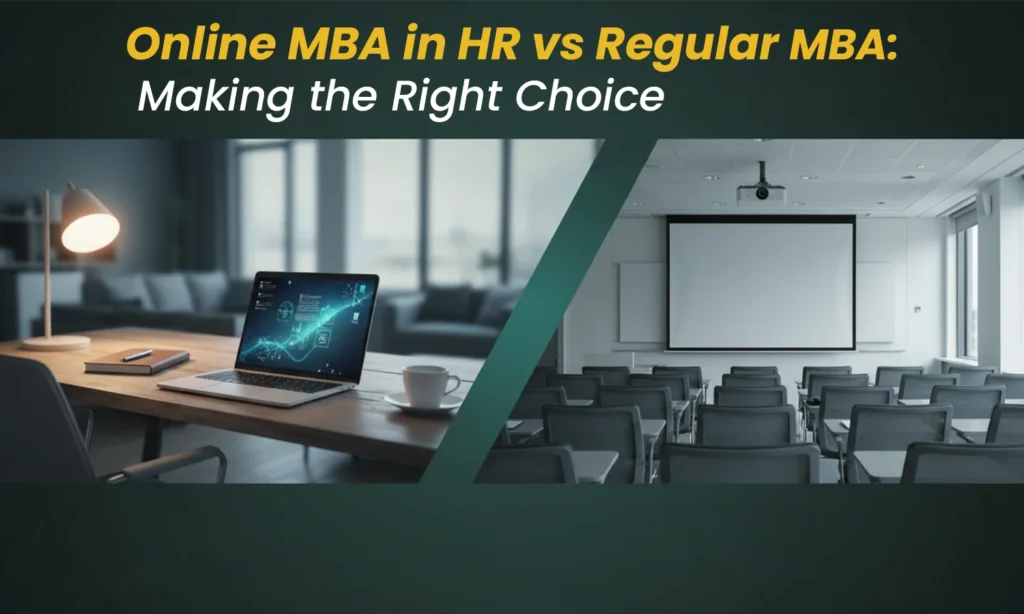
Key Takeaways ➤ Recognition: Both degrees are equally valid in India if they are UGC-entitled. ➤ Flexibility: Online programs let you work while you learn, whereas regular ones require you to be present on campus every day. ➤ Cost Savings: You save significantly on tuition and travel with an online degree. ➤ Career Boost: Both paths lead to high-level management roles in top companies. How does an Online MBA in HR differ from a Regular MBA in HR? The biggest difference is how you experience your daily life as a student. In an offline MBA in HR, you are expected to be on campus for fixed hours. You attend live lectures in a physical classroom and participate in face-to-face group activities. It is a full-time commitment that usually means you cannot hold a job at the same time. An online MBA in HR is built for people who need more freedom. You don’t have to move to a new city or quit your current job. At Online SRM, we use a digital learning platform where you can access recorded sessions and live evening classes. This means you can study from your couch after work or during your commute. While a Online mba in hr vs regular MBA gives you the campus vibe, an online degree gives you the gift of time. How do the core HR subjects differ between online and regular MBA programs? You might think the subjects change based on the mode of study, but the core elements of the degree stay the same. Both programs aim to turn you into a leader. However, the subjects in the Online MBA in HR at Online SRM often have a modern twist to help you work better in digital offices. In a regular MBA, you spend a lot of time on traditional theories. In our online program, we focus on how those theories work with today’s tech. For example, instead of just learning how to hire people, you learn about IT in Talent Acquisition. You also dive into HR Strategy and Analytics, which teaches you how to use data to make better team decisions, a skill that is very high in demand right now. Understanding the Online Vs Regular MBA HR Degree Differences Feature Online MBA (Online SRM) Regular MBA (On-Campus) Learning Mode 100% Online with Mentorship Physical Classroom / Campus Attendance Flexible (recorded + live sessions) Mandatory (fixed schedule) Semester Fee ₹27,500 ₹76,400 Total Fee ₹1,10,000 ₹3,00,000+ (estimated) EMI Option ₹4,584 per month Varies by Bank Networking Global Digital Community Local Campus Peers Ideal For Working Professionals Fresh Graduates Which Is Better: Online MBA vs Regular MBA in HR? It really comes down to your current situation. If you are a fresh graduate who wants to enjoy university or the in-campus life and can afford not to work for two years, the regular MBA is a classic choice. You get to interact with people in person every day and follow a very set routine. However, if you are already working or want to start your career early, then you should study an MBA in HR management online. It is much more practical for the modern world. One of the main advantages of an MBA in HR online is that you don’t have to choose between a paycheck and a degree. You get both. Plus, with the affordable fees and EMI options at Online SRM, you get the same NAAC A+ brand value without the heavy student loans. FAQs Is An Online MBA Equal To An Offline MBA? Yes, as per the latest UGC guidelines, an online degree from a recognized university like SRM holds the same value for jobs and government exams as a regular degree. Do Online MBAs Offer The Same Career Options As Regular MBAs? Yes, top companies hire based on your skills. Our online mba hr programs include placement support to help you find roles in MNCs, startups, and the public sector. Who Is Better Suited For A Regular MBA In HR? A regular MBA is best for fresh graduates who want a structured environment and can dedicate two full years to on-campus learning without a job.
Is an MBA in HR Worth It After Graduation? A Complete Career Guide

Introduction For any recent graduate or young professional, the decision to pursue a Master’s degree is a major step towards his/her career. In a generation where AI is automating tasks and remote work where people used to do earlier is the new norm, the “people” side of business has never been more critical. This is where MBA Human Resource Management comes into play. If you are asking, “Is an MBA in HR worth it?”, the answer is based on your career goals and what you want to pursue. In 2026, HR has moved far beyond just “hiring and firing”; it’s more about data, strategy, and employee experience nowadays. You may be looking at an online MBA in human resources or a conventional path, this guide will help you decide what you need to understand in this course. Why Is HR An Important Career Choice Today? The modern workplace is nowadays complex. Companies today face the “Great Reshuffle,” the rise of hybrid work, and a massive focus on mental health. HR professionals are no longer just administrators; they are the strategic partners who help organizations survive and thrive. Specializing in HR means you are responsible for: ➤ Building Culture: Ensuring employees feel connected, even if they work from different countries. ➤ Managing Diversity: Creating inclusive spaces where every voice is heard. ➤ Driving Growth: Finding and training the talent that will lead the company into the future. Is An MBA In HR Worth It? Here Are The 7 Advantages Of Getting An MBA In HR: 1. Strategic Leadership Roles: Unlike a general degree, an MBA allows you to skip entry-level clerical roles and start directly in management roles. 2. High Earning Potential: In India, the average online MBA in human resource management salary for freshers can range from ₹5 LPA to ₹8 LPA, with senior roles crossing even ₹20 LPA. 3. Cross-Industry Demand: Every sector, from IT and Healthcare to Manufacturing, needs HR. You aren’t tied to one industry. 4. Global Opportunities: HR principles (like labor laws and talent management) are universal, opening doors to global MNCs. 5. Job Stability: While technology changes, the need for human-to-human interaction and conflict resolution never goes away. 6. Developing Soft Skills: You become a negotiation expert, learning about human psychology in what employees expect to be treated, and leadership skills that AI cannot easily replicate. 7. Professional Networking: Joining a program like Online SRM Sikkim gives you access to a massive alumni network of over 170,000+ professionals. What Skills Will Be Most In Demand For HR Professionals In The Future? To stay relevant, the skills required for MBA HR graduates have evolved. In the next 10 years, you will need: ➤ HR Analytics: Using data to predict which employees might leave and why. ➤ Digital Transformation: Being comfortable with AI-driven hiring platforms and virtual onboarding tools. ➤ Emotional Intelligence (EQ): The “human touch” needed to handle workplace stress and mental health. ➤ Strategic Thinking: Understanding the business’s financial goals as well as you understand its people. Why Choose An MBA In HR From Online SRM? At Online SRM Sikkim, our MBA with HR specialization is designed for the future. We combine traditional management wisdom with emerging technology to make you “industry-ready” from Day 1. ➤ Affordability: Our online MBA in HR in India is cost-effective, with semester-wise fees starting at ₹27,500. ➤ Flexibility: Our MBA in HR for working professionals features an AI-driven personalized learning platform, letting you study without quitting your job. ➤ UGC-Entitled: Your degree is recognized globally and is valid for government and private sector jobs. ➤ Placement Support: We don’t just teach; we help you get hired through mock interviews, resume-building sessions, and job fairs. FAQs Can You Get A Job After An MBA In HR? Yes, for suggestions, you can land in specialized roles like HR Business Partner, Talent Acquisition Specialist, or HR Analytics Manager across various industries. Will MBA Jobs Be Replaced By AI?No, while technology like AI automates administrative and repetitive tasks, the core human elements like leadership, mentoring, and resolution of conflicts remain irreplaceable. Is An MBA In HR Difficult To Pass? Not at all, if you enjoy working with people and understanding how businesses run, you will find it very manageable because the course focuses more on practical life skills like negotiating and leadership , than complex math or hard science. Is An MBA In HR Suitable For Recent Graduates? Absolutely, it provides freshers with a competitive edge and higher starting salaries by preparing them for management roles immediately.
Master Logic Before AI: Decision Making & Loops Explained at Online SRM

In the rush to build the next big Artificial Intelligence, many students make the mistake of jumping straight into complex neural networks and machine learning models. But here is a secret: AI is essentially a massive web of logic. If you don’t understand how a computer makes a simple choice or repeats a task, building an “intelligent” system is like trying to write a novel before learning the alphabet. At Online SRM Sikkim, we believe in building strong foundations. Before you touch a single AI library, you must Master Logic Before AI. This starts with two pillars of programming: Decision-Making and Loops. Why is Logical Thinking Important Before Learning AI? Artificial Intelligence doesn’t actually “think” like a human, it calculates like a machine. It follows a series of logical steps to conclude. If your underlying logic is flawed, the AI will produce “hallucinations” or incorrect results. Learning logic through a computer science degree teaches you problem-solving and decision-making. It trains your brain to break down massive problems into tiny, solvable steps (a process called decomposition). Without this skill, AI becomes a “black box” that you use but never truly understand. Mastering logic ensures you are the one controlling the technology, not the other way around. What is Decision Making in Programming? At its core, Decision-Making is about giving your program the power to choose. In the real world, you decide to carry an umbrella if it is raining. In programming, we use “Conditional Statements” like if, else, and switch to do the same. ➤ The “If” Statement: “If the user’s age is over 18, allow access.” ➤ The “Else” Statement: “Otherwise, show an error message.” In AI, decision-making is everywhere. From a self-driving car deciding whether to brake, to a chatbot choosing the right response, it all starts with these basic “if-then” conditions. What are Loops in Programming, and Why are They Important? Imagine you had to print the word “Hello” 10,000 times. You wouldn’t write 10,000 lines of code; you would use a Loop. Loops allow a program to repeat a specific block of code as long as a certain condition is met. ➤ For Loops: Used when you know exactly how many times you want to repeat (e.g., checking every student in a class of 50). ➤ While Loops: Used when you want to keep going until something changes (e.g., keeping a game running until the “Game Over” condition is met). In AI, loops are used to “train” models. The machine “loops” through millions of data points, learning a little bit more with every repetition until it becomes accurate. How Online SRM Teaches Decision Making & Loops for BCA Students Our online degree programs at SRM University Sikkim are designed to turn beginners into logic masters. We don’t just give you syntax; we give you scenarios. ➤ Practical Lab Sessions: Even in an online format, our BCA students work on real coding environments to practice if-else and for-while constructs. ➤ Industry-Aligned Curriculum: Our syllabus starts with “Programming for Problem Solving,” ensuring you master the basics before moving to advanced AI and Machine Learning modules. ➤ Expert Guidance: You learn from faculty who show you how a simple loop in C or Python eventually evolves into the training cycle of a Deep Learning model. FAQs Can Beginners Learn Programming?Yes! Everyone starts at zero. Programming is less about math and more about language and logic. If you can follow a recipe or give someone directions, you can learn to code. Why Is Mastering Logic So Difficult? It feels difficult because it requires a different way of thinking. Humans often skip steps because we “just know” things. Computers need every single tiny step explained. Once you get used to that level of detail, it becomes second nature. Can You Learn AI Without Understanding Decision-Making?You might learn to use AI tools, but you will struggle to build or fix them. Understanding the decision-making logic is what separates a “user” from a “developer.”
What Is the Future Scope of MBA in HR in the Next 10 Years?
The workplace has changed more in the last three years than it did in the previous thirty. As we look toward 2030 and beyond, the “Human” in Human Resources is becoming more valuable than ever. If you are considering doing an MBA in Human Resource Management, you are not just looking at a job; you are looking at becoming the architect of the modern workforce. The future scope of MBA in HR is expanding from simple administrative and managing tasks to high-level strategic leadership. You may be exploring online MBA HR programs or traditional degrees, but the next decade promises a landscape where HR professionals are the most critical link between technology and talent. How Will the Role of HR Evolve Over the Next 10 Years? In the next decade, the future of MBA in HR will shift from “hiring and firing” to “experience and empathy.” Companies are moving away from rigid office structures to hybrid, global, and gig-based models. This means HR leaders will be responsible for maintaining company culture across different time zones and digital screens. Graduates of HR management master’s programs will find themselves focusing on: ➤ Employee Wellbeing: Mental health and work-life balance will become core business metrics. ➤ Diversity & Inclusion: Building truly global teams that represent a variety of perspectives. ➤ Organizational Design: Helping companies stay adaptable so they can pivot and sustain during global market changes. What Impact Will AI Have on the Future of MBA in HR? A common question is: “Will AI replace HR?” The short answer is no, but HR professionals who use AI will replace those who don’t. In an MBA in HRM, students now learn how to leverage automation to remove bias from recruiting and use predictive analytics to spot when a top employee might be thinking of leaving. AI will handle the repetitive tasks, like going through resumes or answering basic policy questions, allowing HR managers to focus on the complex human side of business, such as conflict resolution and leadership coaching. This technological shift is a major reason why an online MBA in HR in India is becoming so popular, as these programs often integrate the latest digital tools directly into the curriculum. Which Skills Will MBA HR Graduates Need to Succeed in the Future? To stay relevant in the future scope of MBA in HR, you will need a mix of “heart” and “data.” The next ten years will reward those who possess: ➤ Data Literacy: The ability to read “People Analytics” to make better business decisions. ➤ Digital Fluency: Being comfortable managing teams via virtual reality (VR) or advanced collaboration platforms. ➤ Strategic Thinking: Understanding the business’s bottom line as well as the CFO does. ➤ Cultural Intelligence: The ability to manage talent from diverse backgrounds and geographical locations. How Does an MBA in HR Prepare Students for the Future? An MBA in HR management online at Online SRM Sikkim acts as a bridge to the gap between today’s practices and tomorrow’s needs. By pursuing a Master’s in HRM, you gain a comprehensive understanding of: ➤ Labor Laws in the Digital Age: Navigating the legalities of remote and international hiring. ➤ Strategic Talent Management: Learning how to identify and nurture the leaders of the future. ➤ Change Management: Mastering the art of leading an organization through technical or structural transitions. Step Into the Future with Online SRM The next 10 years will belong to those who can balance technology with a human touch. At Online SRM Sikkim, our online MBA HR programs are built to ensure you are ready for the challenges of 2030 and beyond. FAQs Does HR Have A Scope In The Future?Absolutely. As long as there are people in a company, you need a professional to manage, motivate, and protect them. The scope is shifting from “support staff” to “strategic business partner.” Is An MBA In HR A Good Career Choice For The Future?Yes. It is one of the most stable career paths. With the rise of the “Great Resignation” and shifting worker priorities, companies are willing to pay a premium for skilled HR leaders who can retain top talent. Does An MBA In HR Have Global Career Opportunities?Yes. Since human behavior and the need for organized management are universal, an MBA in HR allows you to work across borders, especially in multinational corporations (MNCs) that require global HR strategies.
Top 10 Supply Chain Project and Mini-Project Ideas for Final Year Students

Overview Choosing the right supply chain project topics helps MBA students connect academic concepts with practical industry problems. This blog covers project and mini-project ideas in logistics, procurement, inventory, technology, sustainability, and risk management, along with tools and tips for selecting a suitable topic. Introduction The final year of your degree is often the most defining period of your academic journey. For those pursuing an Online MBA in Operations and Supply Chain Management, the final is not just a submission of a few pages or a presentation, it acts as a bridgproject e between theoretical concepts and the high-stakes world of global logistics. It is your opportunity to prove that you can handle real-world complexities and obstacles, from inventory bottlenecks to last-mile delivery challenges. Choosing the right supply chain project topics can significantly impact your portfolio and catch the eye of top recruiters. You may have enrolled in a Master’s program in supply chain management or an MBA in supply chain management distance learning, but the goal remains the same: solving a problem that exists in the industry today in real life. Why Are Supply Chain Projects Important for Final Year Students? A well-executed MBA SCM project serves as a “professional preview.” In an Online MBA degree in supply chain management, where you might not be physically present in a warehouse or factory daily, the project acts as a simulation of actual workplace challenges. It allows you to demonstrate: ➤ Analytical Skills: Your ability to interpret data and find inefficiencies. ➤ Problem-Solving: Moving beyond textbooks to find real-life, cost-effective solutions. ➤ Industry Readiness: Showing potential employers that you understand current market trends like automation and sustainability. Students can also use supply chain management case studies to understand how businesses handle challenges involving inventory, procurement, transportation, and distribution. Top 10 Supply Chain Project and Mini-Project Ideas for Final Year Students Picking the right supply chain project topics is the first step toward a great grade. Here are 10 simplified ideas for 2026: 1. Green Sourcing (Sustainable Procurement): Research how companies can pick suppliers that don’t hurt the environment. It’s about making sure products are made in a way that is good for the planet and the people.This can cover supplier selection, sustainable procurement, packaging, and material sourcing. 2.Super-Fast Delivery (E-commerce Last-Mile): A study on how to get packages to customers in busy cities faster. You’ll look at how to cut down the time it takes for that final trip from the local hub to the customer’s door.This is one of the practical logistics project topics that can examine delivery time, route planning, and transportation costs. 3. Food Tracking with Tech (Blockchain): Using new technology to track food from the farm to the grocery store. This helps make sure food is fresh and tells us exactly where it came from if someone gets sick.Students can study food traceability, supplier records, and information sharing. 4. Predicting What People Buy (AI Forecasting): Using old sales data to guess what people will want to buy next month. This helps big stores make sure they don’t run out of popular items during holidays.This can be developed into a supply chain research topic around demand forecasting, seasonal demand, and inventory planning. 5. Handling Returns (Reverse Logistics): Looking at how companies take back old or broken electronics. This project focuses on how to fix, recycle, or throw away “e-waste” without losing money.The project can examine returns, recycling, refurbishment, and disposal costs. 6. Backup Supplier Plans (Vendor Risk Management): Creating a plan so a company doesn’t fail if one supplier shuts down. It’s about having “Plan B” and “Plan C” suppliers ready in case of a global crisis.Students can focus on supplier diversification, risk identification, and contingency planning. 7. Robots in the Warehouse (Automation ROI): Comparing the cost of hiring people versus buying robots for a warehouse. You’ll figure out if the robots actually save the company money in the long run.This can cover automation costs, productivity, labour requirements, and expected returns. 8. Safe Medicine Shipping (Cold Chain): A project on how to keep medicines at the right temperature while they travel to faraway villages. This is vital for keeping vaccines and life-saving drugs effective.Students can study temperature monitoring, transportation, storage, and cold-chain management. 9. Cutting Out Waste (Lean Inventory): Studying how to keep only the stock you need “just in time.” This helps companies save money because they aren’t paying for big warehouses to hold extra stuff. This topic can examine inventory levels, stockouts, excess inventory, and carrying costs. 10. Better Shipping Routes (Global Resilience): Looking at different paths ships can take across the ocean. If one major canal or port is blocked, how can ships find a faster way to get goods to port?This can focus on alternative routes, shipping delays, port dependencies, and supply chain resilience. What are the Supply Chain Mini-Project Ideas for the Final Year Students? If you are looking for logistics topics for MBA project work that are more contained or suitable for a shorter duration, mini-projects are an excellent way to focus on a specific niche. ➤ Audit of a Local Retailer’s Inventory: Analyze a local shop’s stock-keeping methods and suggest digital improvements. ➤ Case Study on Packaging Waste: Propose biodegradable alternatives for a specific consumer brand. ➤ Route Mapping for Local Distributors: Use GPS data to find the most fuel-efficient delivery routes for a small courier service. Other supply chain project topics can include supplier evaluation, warehouse layout, procurement costs, and customer returns. Which Tools and Software Can Help in Supply Chain Projects? Modern Supply Chain MBA programs emphasize the use of technology. To make your project stand out, consider using the following: ➤ Tableau or Power BI: For data visualization and dashboarding. ➤ Microsoft Excel (Advanced): Essential for linear programming and inventory modeling. ➤ AnyLogic: Great for simulation modeling of logistics systems. ➤ Python/R: If your project involves heavy predictive analytics or machine learning. The tool should match your research question and the type of data available. Common Mistakes