


MBA in Finance or Business Analytics After BBA: Which Is Better for Your Career?
Key Takeaways ➤ MBA in finance or business analytics after BBA depends on your strengths and career goals. ➤ Finance fits students who prefer structured, number-based work and stable role paths. ➤ Business Analytics fits students who enjoy data-backed decision-making and modern roles. ➤ Online SRM offers a credible, flexible MBA learning experience with expert support. Introduction Choosing an MBA specialization is a serious decision, especially when you are comparing mba in finance or business analytics after bba. Both specializations can lead to strong careers, but they prepare you for different types of work. Finance focuses on money management, investments, and business performance. Business Analytics focuses on data, insights, and decision-making. If you want a flexible, credible option, Online SRM Sikkim offers world-class education through a 100% Online format with a Globally Recognized Degree. With approvals such as UGC-Entitled Program, AICTE-Approved, NAAC A+ Accredited, students can pursue MBA in Finance or Business Analytics after BBA with confidence, supported by Subject Matter Expert faculty and an Industry-Aligned Curriculum. Differences Between an MBA in Finance and an MBA in Business Analytics When deciding mba in finance or business analytics after bba, start by understanding how they differ: ➤ MBA in Finance: Focuses on budgeting, financial planning, investments, risk, and corporate finance. The MBA in finance scope is strong in banks, corporates, consulting, and investment-related roles. ➤ MBA in Business Analytics: Focuses on data analysis, business reporting, tools, and decision support. It connects business goals with data-driven strategy and is often linked with tech-enabled roles. If you’re reviewing academics, the MBA in finance syllabus usually includes accounting, corporate finance, economics, risk, and markets. In comparison, MBA business analytics typically includes statistics, data visualization, predictive analysis, and business intelligence concepts. What Are the Skills Required for an MBA in Finance vs an MBA in Business Analytics? To choose mba in finance or business analytics after BBA, match the specialization to your strengths. Finance skills ➤ Comfort with numbers and financial logic ➤ Strong attention to detail ➤ Risk understanding and decision-making ➤ Ability to interpret reports and trendsMany students ask about subjects in MBA finance because they want clarity before choosing, and finance is best for those who like structured, numbers-based work. Business Analytics skills ➤ Interest in data and problem-solving ➤ Curious to find patterns and insights ➤Basic comfort with tools and reports Ability to explain data in business termsIf you enjoy decision-making backed by data, business analytics can fit well. What Career Opportunities Are Available After MBA in Finance for BBA Graduates? For students choosing mba in finance or business analytics after bba, finance offers clear career paths across industries. Common roles include: ➤Financial Analyst ➤Corporate Finance Executive ➤Risk Analyst ➤Investment Support Roles ➤Finance Associate in consulting The strongest jobs after MBA in finance usually appear in banks, NBFCs, corporate finance teams, and investment-led companies. Finance is a good fit for students who want stable career tracks with defined growth levels. What Career Opportunities Are Available After MBA in Business Analytics for BBA Graduates? Business Analytics roles are expanding as companies rely more on data for decisions. For students choosing an MBA in finance or business analytics after bba, analytics can lead to roles like: ➤ Business Analyst ➤ Data-driven Operations Analyst ➤ Reporting and Insights Analyst ➤Strategy Support Associate ➤Product or growth support roles Many students also compare income outcomes. While salaries vary by skill and role, the market often discusses MBA in business analytics salary as competitive in data-focused roles, especially when paired with a strong business understanding from BBA. How Can a BBA Graduate Decide Which MBA Specialization Is Right for Them? To decide mba in finance or business analytics after bba, ask yourself three practical questions: Do you enjoy structured number-based work (finance) or pattern-based decision work (analytics)? Do you want finance-led roles or data-led roles? Do you prefer traditional corporate finance paths or cross-functional business problem solving? If you are still unsure, choose a university that offers strong academic guidance and support. Online SRM’s MBA is designed with an Industry-Aligned Curriculum, supported by Placement Assistance, and delivered through flexible online learning. For students exploring online MBA courses, SRM’s model works well because it supports consistent learning without disrupting your routine. FAQs Can You Do Finance Courses Online After a BCom?Yes, many online options exist, but choose a recognized program with strong academic support. Is an MBA in Finance the Best Option after a BCom?It can be, if you want finance-focused roles like analysis, risk, and corporate finance. Which Course Is Best for Finance?An MBA in Finance is a strong choice for long-term finance career growth.
Top 5 Banking Courses After B.Com for a Successful Career
Overview Banking Courses After B.Com can help commerce graduates build specialised knowledge for careers across banking and financial services. Options include finance and analytics programmes, banking diplomas and banking certification courses. The right choice depends on career interests, preferred job roles, learning format and long-term professional goals. Key Takeaways ➤ Banking Courses After B.Com help you build practical skills for banking roles and BFSI careers. ➤Banking careers today include operations, credit, risk, analytics, and digital banking support. ➤ MBA, banking diplomas, and finance certifications can improve job readiness. ➤Online SRM offers flexible, credible learning designed for modern banking career needs. Choosing Banking Courses After B.Com is a common and practical step for commerce graduates who want stable jobs, structured growth, and long-term career security. Banking roles today are not limited to branch work. They cover customer management, credit processing, operations, risk, compliance, and digital banking support. That is why many students who plan banking after B.Com look for a course that improves skills and gives a clear career direction. Online SRM Sikkim supports postgraduate learning through world-class education in a 100% Online format, offering a Globally Recognized Degree with approvals such as UGC-Entitled Program, AICTE-Approved, and NAAC A+ Accredited. With expert-led learning and flexible schedules, students can pursue banking-focused growth without relocating. For graduates comparing banking courses after graduation, it is useful to look beyond the course title. The curriculum, duration, recognition, delivery format and relevance to the intended banking role can all influence the value of a programme. A student interested in credit may need different preparation from someone targeting analytics or financial operations. Why Banking Courses Are Important After B.Com? A B.Com degree builds your base in accounts and business fundamentals, but banking roles often need more practical skills and role-readiness. This is why Banking Courses After B.Com matter. They help you understand how banks work, how financial products are managed, and how customer and compliance processes operate. Banking is also closely linked to the BFSI sector, which includes banking, financial services, and insurance. Many students search for bfsi meaning because the term appears in job roles and hiring portals. In simple terms, BFSI refers to the ecosystem of companies that provide financial products such as loans, deposits, investments, and insurance. If your goal is a bank job after B.Com, a relevant course can improve your understanding and make you more confident in interviews and entry-level roles. The availability of different banking courses for commerce students also means graduates can choose a learning path according to their interests. Commerce graduates already have exposure to areas such as accounting, economics and business, which can provide a useful academic foundation when moving into banking-focused studies. For students researching banking jobs after B.Com, it is also important to understand that banking careers cover multiple functions. Opportunities can relate to branch operations, credit, financial analysis, customer service, risk management, compliance and digital banking. Additional education can help students develop knowledge that is relevant to the particular role they want to pursue. Top 5 Banking Courses After B.Com for Career Growth Here are five practical Banking Courses After B.Com that students commonly choose for career growth: 1) MBA (Finance) An MBA in Finance builds skills in budgeting, reporting, financial planning, and business decision-making. It can support roles in banking operations, credit, and finance teams. An MBA in Finance can be considered by graduates who want broader exposure to financial management along with banking knowledge. It may also be relevant for learners who want to keep their career options open across banking, corporate finance and related financial services roles. 2) MBA (Business Analytics) Banks rely heavily on data for risk checks, customer profiling, and performance tracking. Business Analytics helps you understand data-backed decisions used across modern banking. For students interested in analytical roles, this route connects business knowledge with data interpretation. It can be particularly relevant when comparing the best banking courses after B.Com based on a preference for analytics rather than traditional branch-oriented roles. 3) PG Diploma in Banking and Finance This is a job-focused course that covers banking basics, operations, customer service, and credit processes, making it useful for entry roles. A postgraduate diploma can be considered by graduates who want focused exposure to banking and financial services. The subjects covered and the recognition of the institution should be checked before enrolling. 4) Certification in Credit, Risk, and Compliance Risk and compliance are core parts of the BFSI industry, and these certifications help you build role-based skills that banks value. There are also several banking certification courses covering areas such as credit analysis, risk management, compliance and financial services. These may work as additional qualifications alongside a degree, particularly for graduates who want to strengthen knowledge in a specific area. 5) Digital Banking and FinTech Certifications Digital banking is growing fast, and FinTech-focused learning supports careers linked to online payments, digital onboarding, and banking tech processes.Digital banking education can be relevant for students interested in how technology is changing financial services. Along with banking certification courses, FinTech-focused certifications can provide specialised knowledge that complements an existing commerce degree. If you are asking, after B.Com, which course is best for banking, the best choice depends on whether you want management growth, analytics roles, or operations-based bank careers. What Factors Should You Consider Before Choosing a Banking Course? Before selecting Banking Courses after B.Com, consider these practical points: ➤ Career goal clarity: Do you want credit, operations, analytics, or customer roles? ➤Course structure: Check if the program builds practical, job-ready skills. ➤ Recognition and credibility: Choose institutions with trusted approvals and strong learning frameworks. ➤Flexibility: Many students need learning that fits work or exam preparation. ➤Long-term growth: Pick courses that support promotions and role progression in banking. If your plan is a long-term banking career after B.Com, you should choose courses that match current industry needs rather than only theoretical content. Students should also compare the programme duration, assessment methods and learning support before making a decision. Someone looking specifically for banking courses
Top 5 PG Courses After BBA for Careers in Management and Business Analytics
Overview Choosing the right PG Courses After BBA can help graduates build specialised skills and prepare for broader career opportunities. From an MBA in Business Analytics and Finance to Marketing and Business Management, the right postgraduate program depends on your interests, career goals, and preferred learning format. Key Takeaways ➤ PG Courses After BBA help you move into higher roles faster than only a UG degree. ➤MBA in Business Analytics supports modern decision-making and data-based roles. ➤ MBA in Business Management supports leadership and broad business career paths. ➤Choose PG based on interest, job goal, and learning style. ➤Online SRM can support BBA graduates through online MBA options and specialization learning. Many students enjoy BBA because it gives a clear base in business and management. But once you finish, the next question comes up quickly: PG Courses After BBA or job first? A PG degree is helpful when you want better roles, higher pay, and faster growth in your career. It also helps if you want to move into business analytics, strategy, or leadership roles. This blog will help you understand the best options, explain why an MBA in analytics is popular, and how to pick the right PG program based on your goals. If you are confused about PG Courses After BBA, this guide will make the choice easier. Why BBA graduates should pursue a PG in Management and Business Analytics A BBA degree teaches business basics, but many roles today expect more than basics. Companies want people who can understand business numbers, handle teams, and make decisions using data. That is why PG Courses After BBA in management and analytics are getting more attention. If you are thinking, what to do after BBA, a PG program can help you move beyond entry-level roles and build specialised knowledge. It also gives you an opportunity to choose a clear direction based on your interests. The career after BBA can become broader when you add skills in areas such as analytics, operations, marketing strategy, or finance planning. Many students start BBA early because it is a popular BBA course after 12th, including options for students considering BBA after 12th arts. After completing the degree, higher studies after BBA can help them develop deeper knowledge and prepare for specialised business roles. Top 5 PG Programs to Pursue After BBA for High-Growth Careers Students often ask, what to do after BBA, and the answer depends on the field they want to enter. Here are five common PG Courses After BBA that can support different career directions. 1) MBA in Business Analytics This is for students who want data-based decision roles. It supports careers such as business analyst, reporting analyst, product support analyst, and growth roles. Students interested in data, reports, and business problem-solving may consider this among the best courses after BBA. 2) MBA in General Business Management This is for students who want leadership, team handling, and broader business roles. It is useful across industries and can support different career options after BBA. 3) MBA in Marketing This works well if you enjoy branding, communication, customer behaviour, sales, and marketing-related business roles. 4) MBA in Finance This fits students who enjoy numbers, planning, budgeting, investment concepts, and corporate finance roles. 5) PG Diploma in Data Analytics or Digital Business This is a good option if you want a shorter PG track focused on practical tools and job-related skills. It can suit graduates looking for focused learning instead of a broad management program. These are some of the common Courses After BBA for students who want to develop specialised knowledge and prepare for different career paths. What Is an MBA in Business Analytics and Why Is It a Top Choice After BBA? An MBA in Business Analytics combines management learning with data skills. You learn how businesses use reports, dashboards, and patterns in data to support decisions. This is why many students consider it among the important PG Courses After BBA, especially when they want modern business roles. It is also relevant across industries because businesses use data for planning, customer understanding, operations, sales, and performance analysis. For many students, this program becomes an option when they are deciding what to do after BBA and want a career that combines business knowledge with data. If you enjoy analysis, planning, and solving problems with numbers, an MBA in Business Analytics can be considered as part of your higher studies after BBA. How Does an MBA in Business Management Benefit BBA Graduates? Business Management MBAs are designed to build leadership and decision-making skills. For BBA graduates, this can be a natural next step because you already have a foundation in business concepts. The MBA adds depth and gives you greater exposure to areas such as strategy, operations, marketing, finance, and organisational management. It also supports wide career options after BBA such as marketing, HR, operations, sales leadership, business development, and management trainee roles. Another benefit is flexibility. A management MBA does not restrict you to one type of job. It provides broad business skills that can be applied across industries.So if you want leadership roles and a wider set of business opportunities, an MBA in Business Management is one of the practical PG Courses After BBA to consider. How to Choose the Right PG Course After BBA? Choosing the right PG Courses After BBA becomes easier when you use a simple filter. First, list what you enjoy: strategy, people management, numbers, marketing, or data. Second, identify the job roles you would like to pursue in two to three years. Third, review the course syllabus and check whether the subjects match your interests and career plans. You should also consider the learning format. Some students prefer campus learning, while others need flexibility because of work or personal commitments. If you need a structured online format, Online SRM offers online MBA programs with specialisations that can support BBA graduates who want management-focused growth.A smart after BBA PG course decision is one that matches your interests and
High-Paying PG Courses After Degree: How to Choose the Right Program

Overview Choosing High-Paying PG Courses After Degree requires more than looking at salary expectations. Students should consider their undergraduate background, career interests, skills, learning preferences and the roles linked to each program. From MBA and MCA to analytics and finance-focused programs, understanding the available post graduation courses can help graduates identify a suitable academic and career direction. Key Takeaways ➤High-Paying PG Courses After Degree should match your interest, not just market noise. ➤ Your UG stream matters while choosing a PG course. ➤ MBA and MCA are popular choices with clear job paths. ➤ Build skills and project work to improve job outcomes after PG. ➤ Online SRM can support learners who want flexible PG study options. Introduction Choosing High-Paying PG Courses After a Degree can feel confusing because every option sounds “good” on paper. But the best PG course is not the same for everyone. Your UG background, your interest, and the kind of job you want matter more than trends. This guide will help you choose High-Paying PG Courses After a Degree in a practical way, so you do not waste time or money on the wrong path. Graduates today can choose from a wide range of post graduation courses across management, technology, finance, analytics and other fields. Instead of selecting a course only because it appears on a popular list, it helps to understand what you will study, what skills you can develop and which career paths are connected to the qualification. Why Is Choosing the Right PG Course Important for Your Career? The PG course you choose decides your next direction. If you pick the right one, you get clearer job roles, better skill growth, and stronger confidence in interviews. If you pick the wrong one, you may feel stuck even after studying more. Also, many students select High-Paying PG Courses After their Degree without checking what the course actually teaches. A PG degree should build real skills, not just add a line on your resume. The smarter way is to match the course with your strengths and your long-term career plan. Your choice can also depend on the type of work you want to do after graduation. A student interested in technology may consider an MCA or data-focused program, while someone interested in business and management may consider an MBA. Reviewing these differences can make the search for the best PG courses more focused. How to Choose the Best PG Course After Your Graduation To choose High-Paying PG Courses After Degree, start with clarity on these points: Check your UG base A commerce graduate and a tech graduate should not pick the same path blindly. For example, a PG course after BCA often works best when it builds deeper computer skills and project work. Pick a direction, not just a degree Ask yourself what you want: management roles, tech roles, finance roles, analytics roles, or a mix. Look at job roles linked to the course Don’t focus only on the course name. Search the roles it leads to and the skills those roles need. Choose a learning mode you can stick to Some students need campus learning. Others need flexible learning due to work or family. Plan your money and time A course that looks high-paying but is too expensive or too time-heavy may not be the right fit right now. When you follow these steps, High-Paying PG Courses After Degree becomes a clear choice, not a guess.Students can also compare the duration, curriculum, admission criteria and learning format of different PG courses after graduation. This makes it easier to understand what each qualification can offer before committing time and money to a program. Top 5 High-Paying PG Courses After Graduation Here is a practical PG courses list after the degree that students commonly consider for strong career growth. Your results still depend on your skills, projects, and experience. ➤ MBA (Master of Business Administration) Great for leadership, business roles, and management tracks across industries. ➤ MCA (Master of Computer Applications) Strong choice for software, IT systems, development roles, and specialized tech areas. ➤ MSc Data Science or Business Analytics Useful if you enjoy working with data, reports, and decision-making support. ➤ MCom or Finance-focused PG programs Good for accounting, banking, taxation, and financial operations paths. ➤ MA in relevant business-linked areas Can work well for roles in education, communication, training, or specific domain tracks. This list covers many PG courses after graduation, but the “best” one depends on your UG stream and the work you want to do daily. When comparing the best courses after graduation, look beyond the degree title. Review the subjects, practical assignments, project opportunities and career paths associated with the program. This can help you understand which option fits your existing knowledge and the skills you want to develop. Career Opportunities and Salary Expectations After PG Courses Salary depends on the role, the company, the city, and your skill level. A PG degree can raise your starting point, but it does not guarantee a high package on its own. For example, students who pursue an MBA often aim for roles like marketing executive, business analyst, HR executive, operations associate, or sales leadership tracks. Students who pursue an MCA often aim for developer roles, testing roles, cloud support, data-related roles, or cybersecurity support roles. If you are thinking, after pg, what next, the answer is simple: build your portfolio. Do internships, project work, certifications, and interview practice. That is what converts a PG degree into a better job. Also, if you come from commerce, you will find many Post-graduate commerce courses that lead to stable careers, but growth becomes faster when you add practical tools and real work exposure. Career scope can vary significantly across different post graduation courses. Students should research the roles associated with a program and identify the technical, analytical, communication or management skills expected for those roles. This can give a more realistic understanding of career opportunities after completing a PG qualification. How Online SRM Supports
How to Choose the Right Higher Studies After BCom
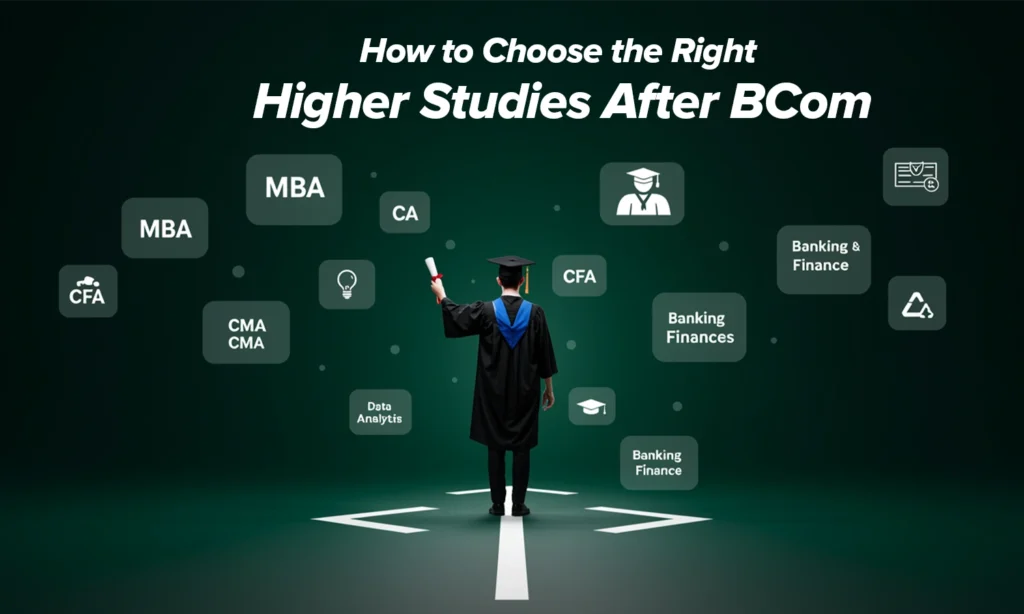
Learners completing a Bachelor of Commerce today stand at a defining crossroads where the right academic and professional choices can shape their long-term success. As business environments grow increasingly competitive and digitally integrated, graduates seek pathways that build both domain expertise and employability. This is why choosing the right higher studies after BCom has never been more important. Across leading universities, there is a consistent trend: learners who strategically select advanced coursework, especially in online, flexible formats, achieve better career outcomes, stronger earning potential, and greater adaptability in the evolving workforce. With verified industry insights and academic best practices in mind, this guide offers clarity on how B.Com graduates can make well-informed decisions about the next phase of their education. How to Choose the Right Higher Studies After B.Com? Choosing a postgraduate pathway requires a thoughtful balance of interest, aptitude, industry trends, and career goals. For B.Com graduates exploring Higher Studies After BCom, the following criteria prove essential: 1. Assess Your Career Interests A successful decision begins with clarity. Whether drawn to finance, management, technology, or entrepreneurship, each interest leads to a different academic route. 2. Understand Market Demand In an economy driven by analytics, digital finance, and technology integration, programmes that develop multidisciplinary skills hold the most future value. Learners often explore online courses after B.Com, professional courses after B.Com, and sector-specific specializations to stay industry-relevant. 3. Consider Flexibility & Mode of Study The rise in online PG courses after B.Com has made quality education more accessible. Online modes offer UGC-recognized degrees, lower cost structures, and the ability to study without career disruptions. 4. Identify Skill Gaps B.Com graduates today increasingly pursue hybrid-learning paths such as management combined with analytics, or commerce paired with technology (e.g., Online MCA after B.Com), to bridge key industry skill requirements. Top Online UG Courses After B.Com Although B.Com itself is a UG programme, many graduates pursue online courses to do after B.Com that upgrade their skills before or alongside postgraduate studies. Some of the most popular and impactful options include: 1. Online MBA (Master of Business Administration) Ideal for those seeking leadership, management, marketing, finance, or HR roles. Online MBA programmes offer flexibility and industry-driven modules. 2. Online MCA (Master of Computer Applications) An excellent pathway for commerce students shifting toward IT, analytics, or tech-enabled business roles. With the rise of fintech and data-driven industries, Online MCA after B.Com has become increasingly relevant. 3. Professional Certification Courses After B.Com ➤Financial Modelling & Valuation ➤Digital Marketing ➤Data Analytics ➤HR Management ➤Banking & Insurance Certifications ➤Accounting tools (Tally, SAP, QuickBooks) These professional courses after B.Com improve employability and prepare graduates for full-fledged PG programs. 4. Online PG Courses After B.Com B.Com graduates often choose postgraduate diplomas or master’s degrees in: ➤Finance ➤Business Analytics ➤Commerce ➤Entrepreneurship ➤International Business ➤Supply Chain & Logistics Each offers strong career outcomes depending on personal interest and industry demand. Online SRM’s Role in Guiding Learners Toward the Right Higher Studies After B.Com Online SRM (Sikkim University) has become a preferred learning destination for commerce graduates seeking quality, flexibility, and career-oriented programmes. What Sets Online SRM Apart? ➤UGC-entitled online degrees ➤Industry-aligned curriculum with practical exposure ➤Experienced faculty with cross-industry expertise ➤Placement and career support resources ➤Cutting-edge digital learning infrastructure Recommended Courses for B.Com Graduates at Online SRM Online SRM’s advanced learning ecosystem supports B.Com graduates through programmes such as: ➤Online MBA – A perfect choice for management aspirants ➤Online MCA – Ideal for learners ready to enter the tech-business landscape Through structured learning, mentorship, and future-ready curriculum design, Online SRM strengthens the academic and professional journey of every B.Com graduate. Want to explore more? Check out our blog on ” How To Choose The Best Online MBA Programs In India“ Is B.Com Better Than BBA?Both are good, it depends on your goal. B.Com suits finance and accounts, while BBA suits management basics. For Higher Studies After BCom, B.Com gives you a solid base for MBA and other PG options. Is BCom Still In Demand?Yes, B.Com is still valued in banking, accounting, and business roles. But Higher Studies After BCom can help you move into better roles faster by adding new skills and specializations. Which Course is Best After BCom?MBA is a popular choice for management careers, and certifications work well for quick skill growth. The best Higher Studies After BCom choice depends on what field you want to enter and what subjects you enjoy. Which Course Has 100% Job Placement?No course can guarantee 100% placement for everyone. What helps is picking the right Higher Studies After BCom program and building strong skills through projects and practice.
Top 4 Best Online PG Courses After B.Com for High-Paying Jobs

A New Era for B.Com Graduates Across today’s competitive landscape, commerce graduates are stepping into a world shaped by finance, data, technology, and global business strategy. Organizations seek professionals who bring both academic depth and advanced specialization, qualities that a strong postgraduate programme provides. As hiring trends continue to evolve, online PG courses after B.Com have emerged as a gateway to leadership roles, analytical careers, and high-growth industries for learners exploring Courses after B.Com graduation. Universities across India and abroad are witnessing an increase in enrolments from B.Com graduates who are eager to enhance their expertise, expand their earning potential, and align with the digital-first economy. The shift is clear: a bachelor’s degree builds a foundation; a master’s amplifies it for long-term success. Why a PG Course After B.Com? A postgraduate qualification delivers several advantages that directly impact employability and salary growth, and Online SRM provides the Best Online PG courses after B.Com. 1. Higher Earning Potential Leading recruitment reports consistently show that candidates with master’s degrees command significantly higher salaries, especially in fields such as finance, analytics, and management. 2. Specialised Skill Development Industries now prioritise niche capabilities like financial modelling, digital marketing, business analytics, and HR technology. PG programmes equip learners with these targeted competencies, paving way for useful B.Com career options 3. Access to Leadership and Strategic Roles Advanced graduates increasingly move into managerial, consulting, and policy-making roles, positions typically not accessible with only a bachelor’s qualification. 4. Enhanced Career Mobility With the commerce field intersecting with technology, analytics, and operations, specialized PG degrees open pathways to cross-functional, global, and remote-first career opportunities. 5. Flexibility Through Online Education Today’s best online PG courses after B.Com offer unparalleled flexibility, allowing students and working professionals to pursue academic excellence without interrupting jobs or personal commitments. Top 4 Best PG Courses After B.Com for High-Paying Jobs These postgraduate programmes are widely recognised for strong recruitment outcomes, industry relevance, and demand across global markets. If you’re wondering what Courses to do after B.Com, below options given help you. 1. Master of Business Administration (MBA) The MBA remains the most in-demand master’s degree for B.Com graduates. It provides an all-encompassing understanding of business strategy, finance, HR, marketing, and operations, thus making it ideal for leadership pathways. Popular MBA Specialisations for B.Com Students: ➤ Finance ➤Marketing ➤ Human Resource Management ➤ Business Analytics ➤ International Business High-Paying Career Outcomes: ➤ Business Analyst ➤Marketing Manager ➤ Finance Manager ➤ HR Business Partner ➤ Operations Consultant The MBA continues to top the list of best courses for B.Com students because of its versatility and global recognition, and many learners consider it the best course for B.Com students aiming for leadership roles 2. Master of Commerce (M. Com) For those seeking academic depth or specialisation in finance, taxation, or accounting, the M. Com offers a strong theoretical and professional foundation.Ideal For:Students interested in teaching and research Aspirants of competitive exams and financial certifications Those looking to strengthen domain expertisePopular Roles: ➤ Financial Analyst ➤Lecturer ➤ Tax Consultant ➤ Corporate Accountant 3. MSc in Data Science or Business Analytics As the digital economy accelerates, B.Com graduates are increasingly transitioning into data-driven careers. Many universities now offer MSc programmes in Data Science, Applied Analytics, or Business Analytics that are open to commerce graduates.This becomes one of the most future-proof BCom-related courses due to the growing demand for analytical roles across industries.Career Outcomes: ➤Data Analyst ➤Business Intelligence Analyst ➤ Pricing Analyst ➤Product Analyser 4. Master’s in Digital Marketing With businesses shifting towards online engagement and digital-first models, a master’s degree in digital marketing has become one of the best online PG courses after B.Com for fast, high-income growth.Skills Covered: ➤Performance marketing ➤Social media strategy ➤ SEO & analytics ➤Content and brand strategy Career Opportunities: ➤Digital Marketing Manager ➤SEO Strategist ➤ Social Media Lead ➤Brand Consultant Check Out Online SRM’s Online PG Courses After B. Com Online SRM (Sikkim University) offers structured and industry-aligned online programmes designed to empower commerce graduates with the right blend of academic rigor and practical expertise. Online SRM Highlights: ➤AI-enabled learning platform ➤UGC-entitled online degrees ➤ Industry-focused curriculum ➤Flexible, exam-friendly learning schedules ➤Accessible for both fresh graduates and working professionals Relevant Online SRM Programmes for B.Com Graduates: Online SRM offers postgraduate programmes including Online MBA and Online MCA, through a fully online format, delivering the same academic rigour as on-campus education via an AI-powered learning platform with live and recorded classes. Both programmes are UGC-entitled (recognized by the relevant authorities), providing a valid degree for further education or employment within India. For students and working professionals seeking flexibility, this design allows completion of a master’s after B.Com without relocating or sacrificing current responsibilities, which is a key advantage of Online SRM’s model. Learners benefit from a supportive digital learning environment, experienced faculty, and strong academic frameworks designed to enhance competencies and employability. Conclusion Today’s commerce landscape belongs to those who choose to grow beyond foundational knowledge and embrace advanced, future-ready specialisations. As industries evolve and global markets expand, postgraduate learning becomes the bridge between aspiration and achievement. By pursuing the most relevant and high-impact online PG courses after B. Com, learners gain the expertise needed to lead, innovate, and excel. With universities like Online SRM (Sikkim University) creating accessible pathways for continuous development, every BCom graduate holds the power to shape a career marked by purpose, progress, and long-term success. FAQs 1. Which Master’s Is Most in Demand After B.Com?The MBA remains the most demanded master’s degree due to its universal applicability, management-focused curriculum, and strong salary outcomes across sectors. 2. Can I Pursue an MSc in Data Science After B.Com?Yes. Many institutions allow B.Com graduates to enrol in MSc Data Science or Business Analytics programmes, provided they meet basic mathematical and analytical prerequisites. A bridging course may be required by some universities. 3. After 12th, Which Course Is Best in Commerce? Popular choices after 12th commerce include:B. ComBBAB. Com (Hons.)BA EconomicsIntegrated MBA Students aiming for high-paying roles often follow these programmes with specialized
What To Do After B.Com? 5 Exciting Career Options

A New Era of Opportunity for B.Com Graduates Commerce graduates today enter a world defined by digital transformation, financial innovation, and data-driven decision-making. Organisations across sectors actively seek professionals who possess not only foundational knowledge but also specialized capabilities. As the employment landscape becomes increasingly skill-centric, the question “What to do after B.Com?” has become more significant than ever. But Online SRM provides a wide variety of courses after B.Com. A B.Com degree provides a strong academic base, yet the most rewarding roles often require advanced training, practical expertise, or a relevant postgraduate qualification. Fortunately, a wide range of courses after B.Com and emerging career pathways now empower graduates to shape successful, future-ready careers. What Are the Most Common Career Paths Available After a B.Com? B.Com graduates have multiple avenues based on their interests, strengths if you’re wondering What to Do After B.Com and long-term goals and if asked after B.Com, which course is best? Let’s dive in:Here’s why your choice of courses to do after B.Com matters: 1. Postgraduate Degrees Students often pursue advanced qualifications or online courses after B.Com, such as: ➤MBA after B. Com (most in-demand and versatile) ➤MCA (for tech-driven roles, depending on eligibility) ➤Specialised master’s programmes such as Digital Marketing, Business Analytics, or Finance 2. Professional Certifications: Certifications enhance credibility and skill specialisation: ➤CA ➤ACCA ➤CFA ➤CIMA ➤Financial modelling certifications ➤Digital marketing certifications 3. Corporate Jobs After B.Com Many graduates directly enter the workforce in areas such as: ➤Accounting ➤Banking ➤Financial services ➤Sales and marketing ➤Operations and administration 4. Online Courses After B. Com Flexible and industry-relevant, these courses help students quickly upskill for high-demand roles. Popular options include data analytics courses, digital marketing, HR analytics, and financial modeling. 5. Entrepreneurship With strong business fundamentals, B. Com graduates often choose to launch ventures in e-commerce, consulting, digital services, or retail. 5 Most Exciting Career Options After B. Com These emerging pathways, shaped by market demand and digital innovation, offer strong career growth and competitive salaries. Two of the most impactful routes are MBA and MCA, complemented by modern skill-based careers. 1. MBA (Master of Business Administration) The MBA remains one of the best courses to do after B. Com, preparing graduates for leadership roles in finance, marketing, HR, operations, and strategy. So, moving on to why an MBA after B.Com is actually a better choice. Career Outcomes: ➤Business Analyst ➤Marketing Manager ➤HR Business Partner ➤Finance Manager ➤Operations Consultant Why it stands out:Its versatility and strong industry demand make the MBA a top choice for those seeking high-growth managerial roles. 2. MCA (Master of Computer Applications) Despite being a tech-centric degree, MCA is increasingly chosen by commerce graduates who want to transition into analytics, automation, AI, or IT roles. Eligibility varies by institution, with some offering bridge courses for non-CS backgrounds.Career Outcomes: ➤Software Developer ➤Data Analyst ➤Business Intelligence Associate ➤Systems Analyst Why it stands out:Tech roles continue to dominate global hiring trends, making MCA a powerful pathway for B. Com graduates eager to enter digital industries. 3. Business Analytics and Data Science Careers Data-driven decision making has reshaped every industry. This creates opportunities for B. Com graduates with strong analytical skills.Popular roles include: ➤Data Analyst ➤Financial Data Specialist ➤Business Intelligence Analyst ➤Market Research Analyst Recommended trainings: ➤Data analytics certificates ➤Business analytics PG programmes ➤AI and ML foundation courses 4. Digital Marketing & Branding Careers Digital transformation has created an urgent need for experts in online strategy, performance marketing, and brand management.Career Outcomes: ➤Digital Marketing Manager ➤SEO Strategist ➤Social Media Lead ➤Content Strategist Why it stands out:This field rewards creativity, agility, and data literacy, making it ideal for B.Com graduates who enjoy dynamic work environments. 5. Professional Finance Careers Many B.Com graduates pursue certifications and roles in specialised finance domains.Career Outcomes: ➤Investment Analyst ➤Tax Consultant ➤Auditor ➤Corporate Finance Executive Popular qualifications: ➤CFA ➤ACCA ➤CPA ➤CIMA Online SRM’s Career Path for B.Com Graduates Online SRM (Sikkim University) offers structured online postgraduate specialisations designed to support the academic and professional advancement of commerce graduatesWhy Online SRM Stands Out: ➤UGC-entitled online degrees ➤AI-powered learning environments ➤Flexible schedules for working professionals ➤Industry-informed curriculum ➤Strong digital academic support Relevant Programmes for B.Com Graduates: Two of the most impactful post-graduation courses after B.Com are the Online MBA and the Online MCA. ➤Online MBA (various specialisations) ➤Online MCA (for eligible students exploring analytics or technology roles) These programmes enable students to stay industry-relevant while studying from any location, making them ideal for those seeking structured post-graduation courses after B.Com without sacrificing personal or professional commitments. Online MBA at Online SRM: A Pathway to Leadership and Strategic Excellence The Online MBA at Online SRM is structured to develop well-rounded business professionals who can take on managerial and strategic responsibilities across industries. The programme blends foundational business principles with modern industry expectations, helping learners build competencies essential for leadership roles. Why the Online MBA Stands Out ➤Comprehensive Curriculum: Covers finance, marketing, human resources, analytics, and operations, making it suitable for B. Com graduates seeking career advancement. ➤Industry-Relevant Learning: Courses integrate contemporary business trends, case studies, and decision-making frameworks. ➤Flexible Format: Enables working professionals and fresh graduates to study without disrupting their schedules. ➤Career Impact: Graduates are well-prepared for roles in business analysis, marketing strategy, finance, HR management, and consulting. For B.Com graduates, the Online MBA becomes a natural progression because it strengthens domain understanding while adding managerial, analytical, and leadership capabilities that employers consistently seek. Online SRM (Sikkim University) has emerged as a strong choice for learners who want academically rigorous yet flexible postgraduate pathways and also for people looking for courses to do after B.Com. Its online programmes are designed to meet national academic standards while offering the convenience and accessibility that today’s learners require. Want to explore more? Check out our blog on ” How an Online MBA Unlocks Career Growth in 2025“ FAQs 1. Which companies hire B.Com students?Commerce graduates are recruited across sectors, including banking, IT services, retail, consulting, fintech, and insurance. Companies such as Deloitte, EY, HDFC Bank, TCS, Infosys,
Top 10 Best Courses After B.Com to Boost Your Career in 2026

Introduction The right and best course after a B.Com degree at the right time can transform a graduate’s entire career trajectory. As 2026 approaches, which is expected to be a year shaped by digitisation, data-centric business models, and global interconnectedness, the opportunities available to B.Com graduates are truly unprecedented.Today, employers are not just looking for degree holders, but they are seeking agile thinkers, digitally fluent professionals, and leaders who can learn, unlearn, and adapt. This blog is my personal guidance to help you choose the next step with confidence when choosing courses after B.Com. Whether you dream of leading a corporation, mastering business analytics, entering finance, or shaping digital transformation, the courses you choose for career options after B.Com will determine the pace and direction of your success.Let’s explore the most impactful courses for B.Com students for your future. Why Choosing the Right Course After B.Com Matters in 2026 The professional landscape for commerce graduates is evolving faster than ever, so choosing the right courses after B.Com is very important. So, having proper career guidance after B.Com is essential. According to industry reports, roles in finance, analytics, digital business, supply chain, and HR management are projected to grow sharply by 2026. Upskilling is no longer optional. Instead, it is your gateway to higher earning potential and strategic roles.Here’s why your choice of courses to do after B.Com matters: ➤Automation is reshaping traditional commerce roles, making analytical and managerial skills essential. ➤Online business and fintech sectors are booming, offering lucrative career paths for specialised learners. ➤Employers now prioritise skill-rich candidates, not just degree holders. ➤Remote and hybrid work models demand strong digital capabilities. Choosing the right course strengthens your foundation and gives you a competitive advantage in fields where B. Com graduates once felt limited. Top 10 Best Courses After B.Com to Boost Your Career in 2026 So if you’re planning to do an MBA after B.Com, below are the top 10 most relevant, industry-preferred and future-proof online MBA and MCA pathways that are specially curated for commerce graduates: 1. Online MBA in Finance Ideal for students wanting to enter banking, financial planning, investment management, and corporate finance, proven to be one of the best courses after B.Com.Covers: Capital Markets, Financial Modelling, Risk Management. 2. Online MBA in Business Analytics Perfect for data-driven roles, which are among the fastest-growing in 2026.Covers: Data Visualisation, Predictive Analytics, AI Applications in Business. 3. Online MBA in Marketing For roles in digital marketing, brand strategy, consumer behaviour, and advertising.Covers: Digital Campaign Management, Market Research, Branding. 4. Online MBA in Human Resource Management Enables careers in talent development, HR analytics, and organisational leadership. Covers: HRIS, Talent Acquisition, Employee Engagement. 5. Online MBA in Supply Chain & Logistics Highly in demand due to global e-commerce expansion.Covers: Logistics Tech, Operations Strategy, Procurement Systems. 6. Online MBA in International Business Prepares students for multinational corporate environments.Covers: Global Markets, Trade Policies, Cross-Cultural Management. 7. Online MCA (for B. Com graduates shifting into tech) Increasingly chosen by commerce students entering IT roles. Covers: Programming Fundamentals, Databases, Cloud Computing.Note: Online MCA is open to B.Com graduates in many universities through bridge courses. 8. Online MCA in Data Science Designed for students wanting to enter analytics or AI-driven roles.Covers: Machine Learning, Python, Data Mining. 9. Online MBA in Entrepreneurship & Innovation Perfect for students aspiring to launch startups or lead growth initiatives.Covers: Design Thinking, Venture Creation, Startup Finance. 10. Online MBA in FinTech A modern, high-demand specialisation aligned with banking digitisation. Covers: Blockchain, Digital Payments, Financial Software Systems. These all prove to be some of the best PG courses after B.Com. What Are the Factors to Consider Before Choosing a Course After B.Com? Before making a decision, students must evaluate their next step based on: ➤Career Goal: Managerial, technical, analytical, or entrepreneurial? ➤Industry Demand: Choose fields with rising opportunities in 2026 ➤Course Recognition: Ensure UGC-entitled or globally accredited programs ➤Learning Flexibility: Online courses offer freedom while balancing work or internships ➤Return on Investment: Check career growth, salary potential, and placement support ➤Skill Alignment: Select a course that builds on your strengths while opening new pathways Which Course Is Best for You in 2026? The answer depends on your personality, skills, and long-term aspirations:Choose MBA Finance if you love numbers and decision-making. Choose MBA Business Analytics if you enjoy data interpretation. Choose MBA Marketing if creativity and communication energise you. Choose MCA or MCA Data Science if you want to enter the booming tech industry.Choose MBA International Business if global roles excite you.Remember: Your best course is the one aligned with your strengths and future vision. Why the Online Mode is the Preferred Route for Modern MBA and MCA Aspirants Online learning is no longer a backup, but it is the mainstream choice for 2026. Verified reports show: ➤Online degrees are now UGC-entitled, equivalent to regular degrees. ➤Working professionals increasingly prefer online programs for flexibility. ➤Digital learning builds competencies essential for today’s hybrid workplaces. ➤Industry leaders recognise online MBAs and MCAs due to their skill-centred structure. ➤Moreover, online programs remove geographical barriers, offering global-quality education from home. Online Courses Offered by Online SRM (Sikkim Campus) Online SRM’s programs are designed with a future-ready curriculum, personalised mentorship, and strong academic support. Below is a sample structured table you requested: Online SRM’s Courses Program Name Eligibility Key Highlights Ideal For Online MBA in Finance B. Com or any UG degree Industry-oriented curriculum, case studies Aspiring finance professionals Online MBA in Business Analytics UG degree with maths preferred Tools like Python, Tableau, Power BI Data-driven roles Online MBA in HRM Any UG degree HR analytics, talent management HR aspirants Online MBA in Marketing Any UG degree Digital marketing modules Marketing & branding careers Online MBA in International Business Any UG degree Global trade insights, export-import training Students aiming for MNCs Online MCA UG degree + bridge courses (if non-CS) Programming, cloud, cybersecurity Tech-oriented learners Online MCA in Data Science UG degree + bridge courses ML, AI, Big Data Data science aspirants Conclusion Your journey after B.
What Are the Best Courses After 12th Without Maths?
Key Takeaways ➤Courses After 12th Without Maths offer strong careers in business and technology. ➤Students can choose degrees like Online BBA and Online BCA from Online SRM. ➤Even without Maths, you can build skills for marketing, HR, IT, or digital jobs. ➤Online learning gives flexibility and helps students gain confidence over time. ➤The right university choice matters as much as the course itself. Introduction Not every student likes Maths, and that is completely okay. Many students from commerce without maths or even Science, without a strong interest in numbers, often worry about their future. The good news is that there are plenty of Courses After 12th without Maths that lead to stable jobs and strong career growth. Your success depends more on choosing a course that fits your interests than on one subject alone. In this blog, we will go through the benefits of choosing the right Courses After 12th without Maths, the degree options available at Online SRM, career paths you can aim for, and how to pick the right university. Benefits of Choosing Online Courses After 12th Without Maths Choosing Courses After 12th without Maths does not limit your future. In fact, for many students, it opens doors to fields that match their strengths better. Here’s why these courses can be a smart choice: First, subjects like management, marketing, communication, and computer applications do not require advanced Maths. They focus more on practical understanding and real-world skills. Second, after 12th courses without maths gives students the freedom to build careers in business, design, tech support, content, HR, and digital industries. These areas have strong demand and steady growth. Third, online degrees make learning easier for students who want flexibility. You can study at your own pace, revise concepts, and build confidence without pressure. Courses Offered by Online SRM Without Maths If you are looking for Courses After 12th without Maths, Online SRM offers undergraduate degrees that suit students from multiple streams. These programs are UGC-approved and designed for current job market needs.Here are the main options: ➤Online BBA (Bachelor of Business Administration): A strong pick for business, marketing, HR, and management careers. This is often seen as the Best course after 12th Commerce without Maths. ➤ Online BCA (Bachelor of Computer Applications): Suitable for students who want IT and software careers, even if they did not study Maths in school. Many students choose BCA after 12th commerce without maths because the course starts from the basics and builds skills step by step. These degrees help students gain practical skills with a flexible study format, without needing a Maths-heavy background. Top Career Options You Can Explore Without Maths Students choosing Courses After 12th without Maths can still build excellent careers. The field you choose depends on your degree and interests.For BBA students, career options include marketing executive, HR assistant, business development associate, digital marketing roles, customer success jobs, and even entrepreneurship. For BCA students, career paths include software testing, web development, technical support, UI design basics, entry-level coding roles, and data handling support. There are many Career options after 12th commerce without maths that pay well if you build skills consistently. Your stream does not decide your success. Your interest and learning effort do. Why Choose Online SRM for Your Degree? Online SRM is part of the SRM Group and offers trusted, recognised online education. When you pick a university for Courses After 12th without Maths, you need to look for credibility, support, and practical learning. SRM provides all three. Students get flexible study schedules, structured semester-wise learning, and support from experienced faculty. The curriculum is designed to help beginners grow steadily, even if they feel unsure in the beginning. Most importantly, Online SRM gives you a Bachelor’s degree without maths pressure, but with strong career value. That balance is what makes it a reliable option for students planning a secure future. Want to explore more? Check out our blog on “Why Online MBA Programs Are the Future of Education“ Conclusion Choosing Courses After 12th Without Maths is not a compromise. It is a smart step when you know your strengths. Many students succeed in business and IT careers without being strong in Maths because their courses focus on practical skills and real-world knowledge. Online SRM supports this journey through UGC-Entitled Online BBA and Online BCA programs that help students learn clearly, grow steadily, and build a career with confidence. If you feel Maths is not your path, you still have many respected degree options waiting for you. FAQs 1. Which job has the highest salary without Maths?High-paying roles without Maths include digital marketing, HR, business development, software testing, and content strategy. Salaries grow as your skills and experience improve. 2. What is the best course to study without Mathematics?Courses like BBA, BCA, BA, and design-related degrees are good options. The best one depends on your interest and career goal, not on Maths. 3. Can I do BCA without Maths?Yes, many universities accept students without Maths in Class 12th. Online SRM’s BCA starts from the basics, so students can learn coding and IT skills step by step.