Overview
The MCA syllabus covers a two-year, four-semester postgraduate program in computer applications. It moves from core programming, data structures, and database systems in the first year to advanced electives like Data Science, AI, cloud, and a final major project. Specialisation tracks and an entrance section round out the structure.
What The MCA Syllabus Actually Covers
The MCA syllabus is built around one goal: turning a graduate into an industry-ready software professional in two focused years. The Master of Computer Applications is a postgraduate degree, and AICTE shortened the earlier three-year format to two years from 2020. That change made the curriculum tighter and more practical.
Across four semesters, the syllabus of MCA balances theory with hands-on labs. You start with programming fundamentals and mathematics, then progress into systems, networks, web technologies, and finally a specialisation with a live project. For anyone comparing an online route with a campus one, the academic content stays broadly the same. Online SRM delivers this through an Industry Aligned Curriculum taught by Subject Matter Experts, with Live plus Recorded Classes so working professionals can keep pace.
Understanding the MCA 2-year course syllabus early helps you plan electives, certifications, and internships around the subjects that matter for your target role.
MCA First Year Syllabus
The MCA 1st year syllabus builds the foundation. Semester one focuses on programming logic, discrete mathematics, and computer organisation. Semester two deepens this with object-oriented programming, database management, and operating systems. These two terms carry the heaviest theory load because everything in year two depends on them.
A well-designed MCA 1st year syllabus also introduces practical labs early, so you write real code from the first month rather than waiting. Most universities keep the syllabus for MCA consistent here because these core papers align with what recruiters expect from a fresher.
MCA Second Year Syllabus and Specialisations
MCA 2- year syllabus opens up in the third semester, which brings advanced topics like software engineering, computer networks, web technologies, and one or two electives. Semester four is largely the major project or internship, which carries significant weight in final grading.
This is the stage where students pick a track. The flexibility inside the MCA 2-year course syllabus lets you angle your degree toward Data Science, Artificial Intelligence, cloud, or cyber security depending on demand and interest.
Semester-Wise MCA Syllabus Table
The table below maps a representative MCA syllabus 2026 across all four semesters. Exact paper names vary by university, so treat this as an indicative structure of the MCA 2026 syllabus rather than a fixed list.
| Semester | Core Subjects | Practical / Focus |
|---|---|---|
|
Semester 1
|
Programming in C, Discrete Mathematics, Computer Organisation, Fundamentals of IT
|
Programming Lab
|
|
Semester 2
|
Object-Oriented Programming (Java/C++), DBMS, Operating Systems, Data Structures
|
DBMS and OOP Labs
|
|
Semester 3
|
Software Engineering, Computer Networks, Web Technologies, Python, Elective I
|
Full-Stack and Networks Lab
|
|
Semester 4
|
Elective II (specialisation), Major Project or Internship
|
Capstone Project
|
This semester view of the MCA syllabus 2026 shows how each term feeds the next. The first year handles fundamentals, the third semester adds depth, and the fourth converts learning into a portfolio-ready project.
MCA Data Science Syllabus Track
The MCA data science syllabus is one of the most sought-after specialisations right now, and for good reason. India’s technology industry is projected to approach roughly US$300 billion in revenue around FY2026 according to NASSCOM, and data roles sit at the centre of that growth.
A typical MCA data science syllabus covers statistics and probability, data wrangling with Python, data visualisation, machine learning fundamentals, big data tools, and a data-focused capstone. Students who take this track often move into analyst and data scientist roles, where average pay in India can reach around ₹15 LPA for experienced data scientists.
MCA AI And ML Syllabus Track
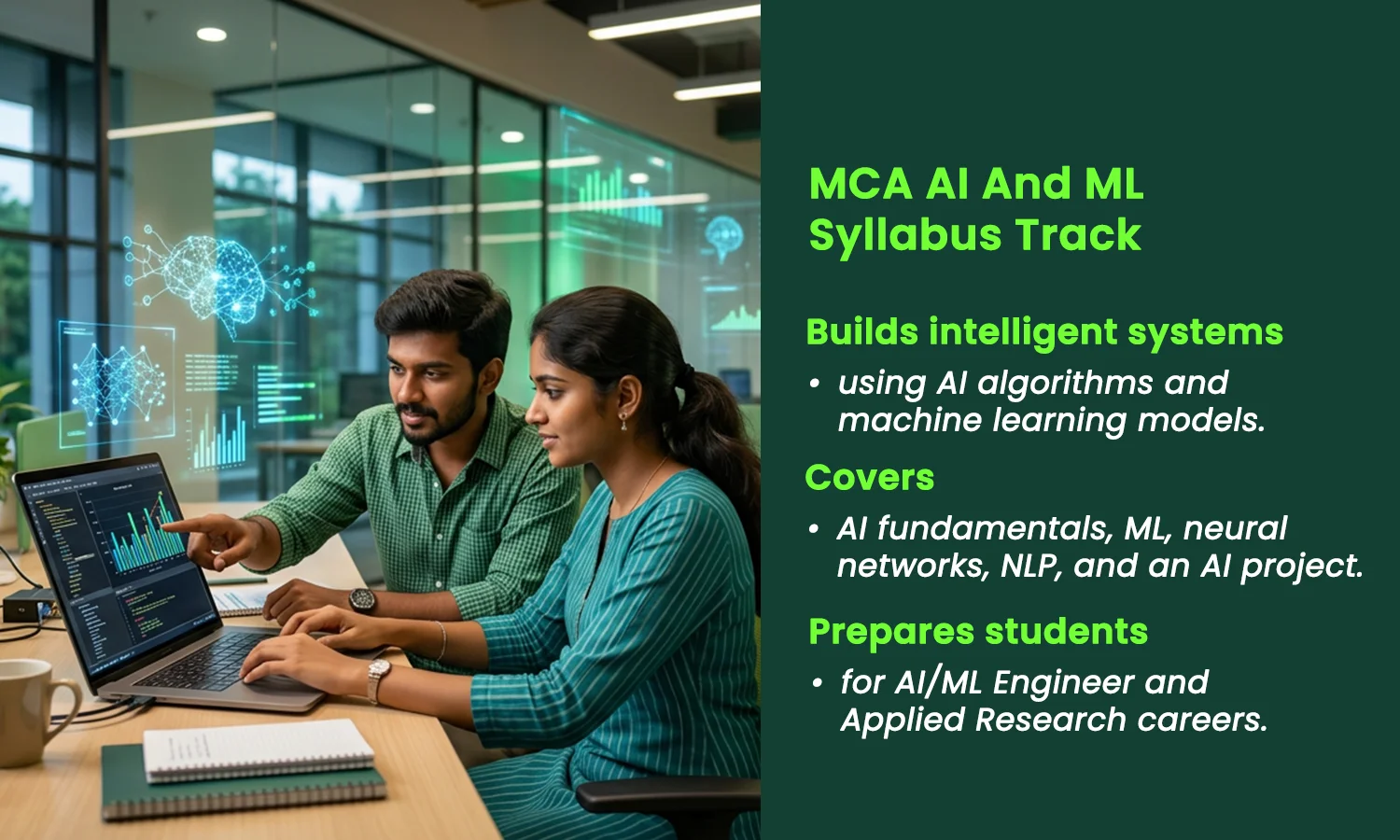
The MCA AI and ML syllabus appeals to students who want to build intelligent systems rather than only analyse data. This specialisation goes deeper into algorithms and model building.
Core papers in the MCA AI and ML syllabus usually include artificial intelligence foundations, supervised and unsupervised learning, neural networks, natural language processing, and an applied AI project. Graduates from this track target AI/ML engineer and applied research roles, which are among the fastest-growing career paths in the country.
MCA Entrance Syllabus
Admission is a separate topic from the academic curriculum. The MCA entrance syllabus for national and state exams like NIMCET, CUET PG, MAH MCA CET, TANCET, and TS ICET typically tests mathematics, logical reasoning, computer awareness, and English.
The MCA entrance syllabus rewards steady preparation in quantitative aptitude and basic programming logic. That said, many universities and most online MCA programs offer merit-based admission without any entrance exam, which suits working professionals who cannot pause their careers to sit competitive tests. Online SRM follows this accessible model with No Relocation Needed and EMI Options Available.
Conclusion
Knowing the MCA syllabus before you enrol lets you choose the right specialisation and career direction from day one. Online SRM offers a UGC Entitled, NAAC A+ accredited online MCA with an industry-aligned curriculum, Placement Assistance, and Affordable Fees that fit a working schedule.
If you want a Globally Recognised Degree without leaving your job, review the program structure and apply for the upcoming intake before seats fill. Your next role in software, data, or AI can start with the right syllabus for MCA and the right platform behind it.
Key Takeaways
- ➤ The MCA syllabus runs across two years and four semesters, moving from core programming to a final major project.
- ➤ The MCA 1st year syllabus locks in fundamentals like DBMS, OOP, and operating systems that year two builds on.
- ➤ Specialisation tracks such as the MCA data science syllabus and the MCA AI and ML syllabus align the degree with high-demand roles.
- ➤ The MCA 2026 syllabus keeps core papers stable while updating electives around cloud, AI, and analytics.
- ➤ The MCA entrance syllabus matters for competitive exams, but online routes often skip it with merit-based admission.
FAQs
What is the MCA syllabus for the 2-year program?
The MCA syllabus spans four semesters, starting with programming, mathematics, and database systems, then advancing to networks, web technologies, and a specialisation. The final semester is a major project. This 2-year MCA syllabus is designed to make you job-ready across software and data roles.
Does the MCA syllabus 2026 include Data Science and AI?
Yes. The MCA syllabus 2026 offers elective tracks, and both the MCA data science syllabus and AI options are widely available. You typically pick a specialisation in the third and fourth semesters, aligning the MCA 2026 syllabus with roles like data scientist or AI engineer.
Is there an entrance exam syllabus for MCA admission?
The MCA entrance syllabus for exams such as NIMCET and CUET PG covers mathematics, reasoning, computer awareness, and English. However, many online programs use merit-based admission, so you may not need the MCA entrance syllabus at all when applying through a flexible online route.
How different is the online MCA syllabus from a regular one?
The academic syllabus of MCA stays broadly the same online and on campus, since both follow UGC and AICTE norms. Online delivery adds Live plus Recorded Classes and an Interactive Online Platform, so the MCA 1st year syllabus and beyond remain equally rigorous.