
Overview
What is HR? HR, or human resources, is both a function and a department that attracts, develops and retains employees. It covers recruitment, pay, learning, performance and employee relations. Here is what HR means, its core functions and responsibilities, the skills it needs and the roles and study options in HR.
What is HR in the simplest terms? It is the part of an organisation that looks after its people. HR finds and hires employees, manages compensation and benefits, supports learning, reviews performance and handles employee relations. It also makes sure the company complies with employment laws and regulations.
HR Full Form and Meaning
The HR full form is Human Resources. The term has two meanings. As a function, it covers the processes and strategies used to attract, develop and retain employees. As a department, it is the team that manages recruitment, compensation, learning, performance management and employee relations. Human resources can also refer to the workforce itself.
You will also see the term Human Resource Management, or HRM. HRM is a systematic approach to managing the company’s workforce to help meet organisational goals.
What Is HR in a Company?
What is HR in a company day-to-day? It is the link between leadership and employees. HR teams typically handle recruitment and onboarding, compensation and benefits, learning and development, performance management and employee relations. Beyond these, HR also takes on workforce planning, talent management and succession planning.
HR’s position in the organisation reflects its importance. The HR department usually reports directly to the CEO or another member of the leadership team, such as the COO.
Core HR Functions
There is no single official list of HR roles. One widely used breakdown from AIHR, an HR learning platform, groups the work into twelve functions.
- ➤ Human resources planning
- ➤ Recruitment and selection
- ➤ Performance management
- ➤ Learning and development
- ➤ Career planning
- ➤ Function evaluation
- ➤ Rewards and compensation
- ➤ Industrial relations
- ➤ Employee communication
- ➤ Health and safety
- ➤ Wellbeing initiatives
- ➤ Administrative responsibilities
Recruitment is often the most visible of these, but the functions work together across an employee’s entire time with the company.
HR Responsibilities and the Tools Behind Them
HR responsibilities cover a large volume of employee records, from attendance and leave to pay and performance reviews. Many HR teams manage this through an employee management system, software that keeps employee information and HR processes in one place. Ensuring compliance with employment laws and regulations remains a core responsibility.
HR Skills That Matter
AIHR highlights four competencies for HR professionals.
- ➤ Communication
- ➤ Administrative expertise
- ➤ Coaching
- ➤ Recruitment
As HR work becomes more data-led, technology and analytics are also part of how HR is taught. The HR and Emerging Technologies specialisation in the Online SRM MBA includes Digital HR Transformation, HR Strategy and Analytics, IT in Talent Acquisition and Management and AI in HR processes.
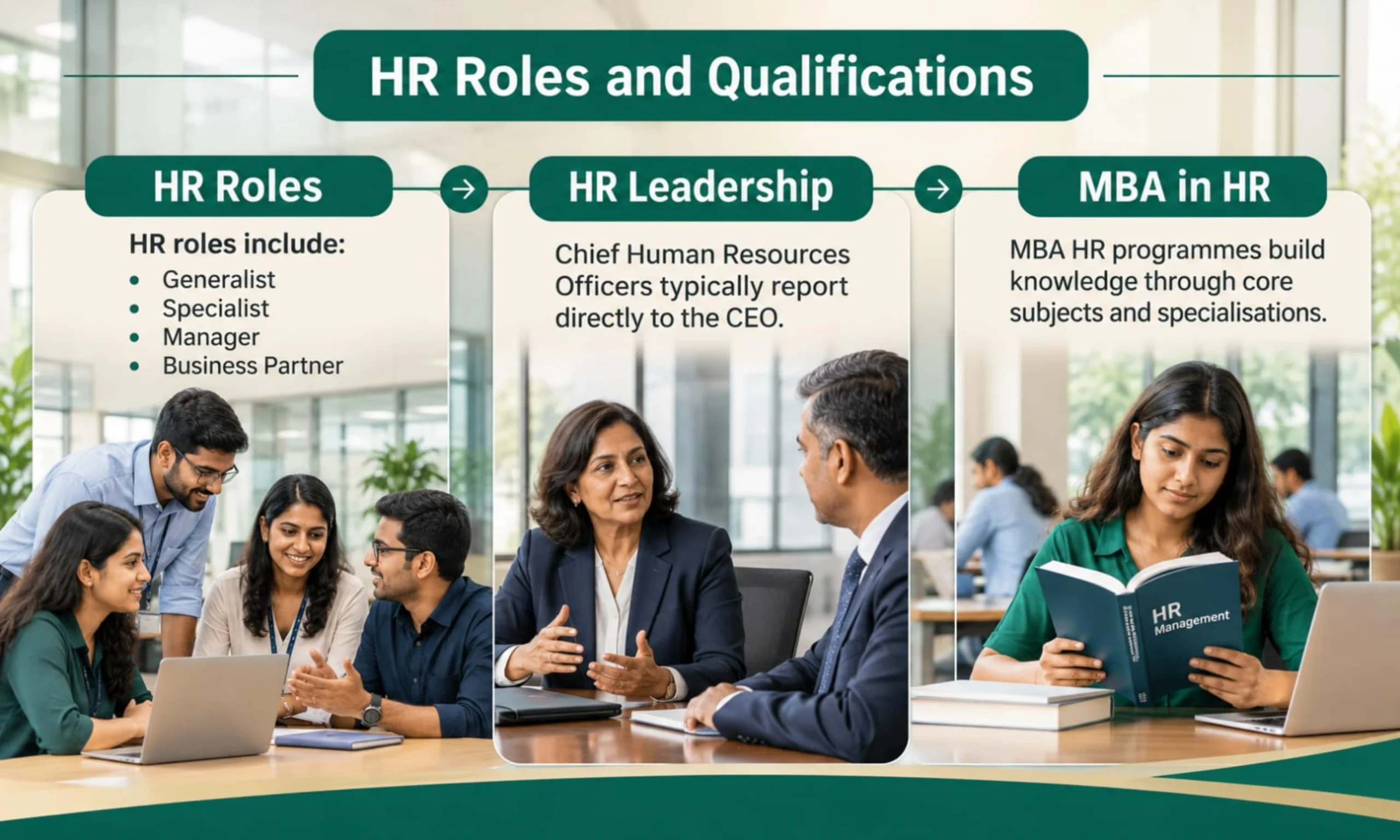
HR Roles and Qualifications
Common HR roles include HR Generalist, HR Specialist, HR Manager and HR Business Partner. At the top of the function, the Chief Human Resources Officer is usually part of the executive team in large organisations and reports directly to the CEO.
If you are asking what is HR as a career, HR qualifications at the postgraduate level often take the form of an MBA with an HR specialisation. In the Online SRM MBA, Human Resource Management is a core subject in the second semester for every student, and the HR and Emerging Technologies specialisation goes deeper in the second year.
Build an HR Career With Online SRM
An online MBA lets you study HR while you keep working. The Online SRM MBA from SRM University Sikkim runs over two years with live faculty sessions, and Career Support Services begin from the fourth semester. Check the programme and apply online.
Key Takeaways
- ➤ What is HR? The function and department that attracts, develops and retains employees
- ➤ The HR full form is Human Resources.
- ➤ Core work includes recruitment, compensation, learning, performance and employee relations.s
- ➤ HR usually reports to the CEO or another senior leader
- ➤ An MBA with a specialisation in HR is a common postgraduate route into HR roles
Conclusion
What is HR at its core? It is the function that helps a company hire, develop and keep the right people while staying compliant with employment law. As HR adopts more technology, study options are changing too. The HR and Emerging Technologies specialisation in the Online SRM MBA is built for people who want to grow in this field.
FAQs
What is HR in a job?
HR is the team that manages recruitment, onboarding, compensation, learning, performance and employee relations. It is usually your contact for workplace policies.
What are the 7 roles of HR?
There is no single official list of seven. Commonly cited HR functions include recruitment and selection, performance management, learning and development, rewards and compensation, industrial relations, employee communication and health and safety.
Is the CEO higher than HR?
Yes. The HR department usually reports to the CEO or another senior leader, and in large organisations the Chief Human Resources Officer reports directly to the CEO.
What does HR mean?
HR means Human Resources. It refers to the function and department that manages employees, and sometimes to the workforce itself.
What is HRM?
Human Resource Management is a systematic approach to managing a company’s workforce to help meet organisational goals.
Which MBA specialisation suits an HR career?
An HR specialisation. At Online SRM, the HR and Emerging Technologies specialisation covers digital HR, HR analytics, talent acquisition technology and AI in HR processes.