Summary
The BBA course duration in 2026 is typically three years and six semesters, but recent education reforms have introduced greater flexibility through multiple exit options and credit transfers. Understanding the timeline, specialisation structure and NEP 2020 framework helps students plan their degree more strategically and maximise long-term career outcomes.
The headline answer to the BBA course duration is three years, structured into six semesters. The fuller answer is more useful because NEP 2020 has fundamentally changed how undergraduate timelines work in India.
The programme can now extend to four years (Honours), shrink to one or two years (via exit options), or pause and resume across institutions through the Academic Bank of Credits. This guide explains the BBA course duration in India in 2026, the implications of NEP 2020, the truth about “shorter” BBA programmes, and what Online SRM offers.
What Is the Duration of the BBA Course in India?
The standard BBA course duration in India is three years, structured as six semesters of approximately five to six months each. The programme totals roughly 120 credits, with five to seven subjects per semester. This three-year structure is the timeline recognised by the UGC for both campus and online modes, and it produces the standard Bachelor of Business Administration degree.
BBA Course Duration After 12th
For learners pursuing the programme right after 12th, the path is straightforward: complete 10+2, apply to a UGC-recognised institution, and enrol in the standard three-year programme. The timeline does not change based on the stream you completed (Commerce, Science or Arts). What differs is the level of pre-existing comfort with business concepts: Commerce students typically find Year 1 subjects more familiar, but the gap closes quickly through the first semester.
BBA Full Course Duration — Year-by-Year Breakdown
| Year | Focus | Duration |
|---|---|---|
|
Year 1 |
Business fundamentals — accounting, economics, communication, mathematics |
~12 months / 2 semesters |
|
Year 2 |
Functional depth — operations, HRM, finance, strategy introduction |
~12 months / 2 semesters |
|
Year 3 |
Specialisation, internship, capstone project |
~12 months / 2 semesters |
|
Total |
Bachelor of Business Administration degree (~120 credits) |
36 months / 6 semesters |
This timeline applies consistently across UGC-recognised institutions in both campus and online modes.
BBA Course Time Duration Under NEP 2020 (3-year vs 4-year Honours)
NEP 2020 introduced a structural change that most older guidance has not caught up with. Under the new framework, the undergraduate programme accommodates both a three-year Bachelor’s and a four-year Bachelor’s (Honours / Honours with Research), with multiple entry-exit options:
- ➤ Exit after Year 1 — Certificate in the discipline
- ➤ Exit after Year 2 — Diploma
- ➤ Exit after Year 3 — Bachelor of Business Administration (the standard BBA degree)
- ➤ Exit after Year 4 — Bachelor of Business Administration (Honours) or (Honours with Research; minimum CGPA 7.5)
Credits earned at each stage are banked in the Academic Bank of Credits and remain valid for lifelong learning. This flexibility is the most significant change to the standard undergraduate timeline in a generation.
Online BBA Course Duration — Same Length, More Flexibility
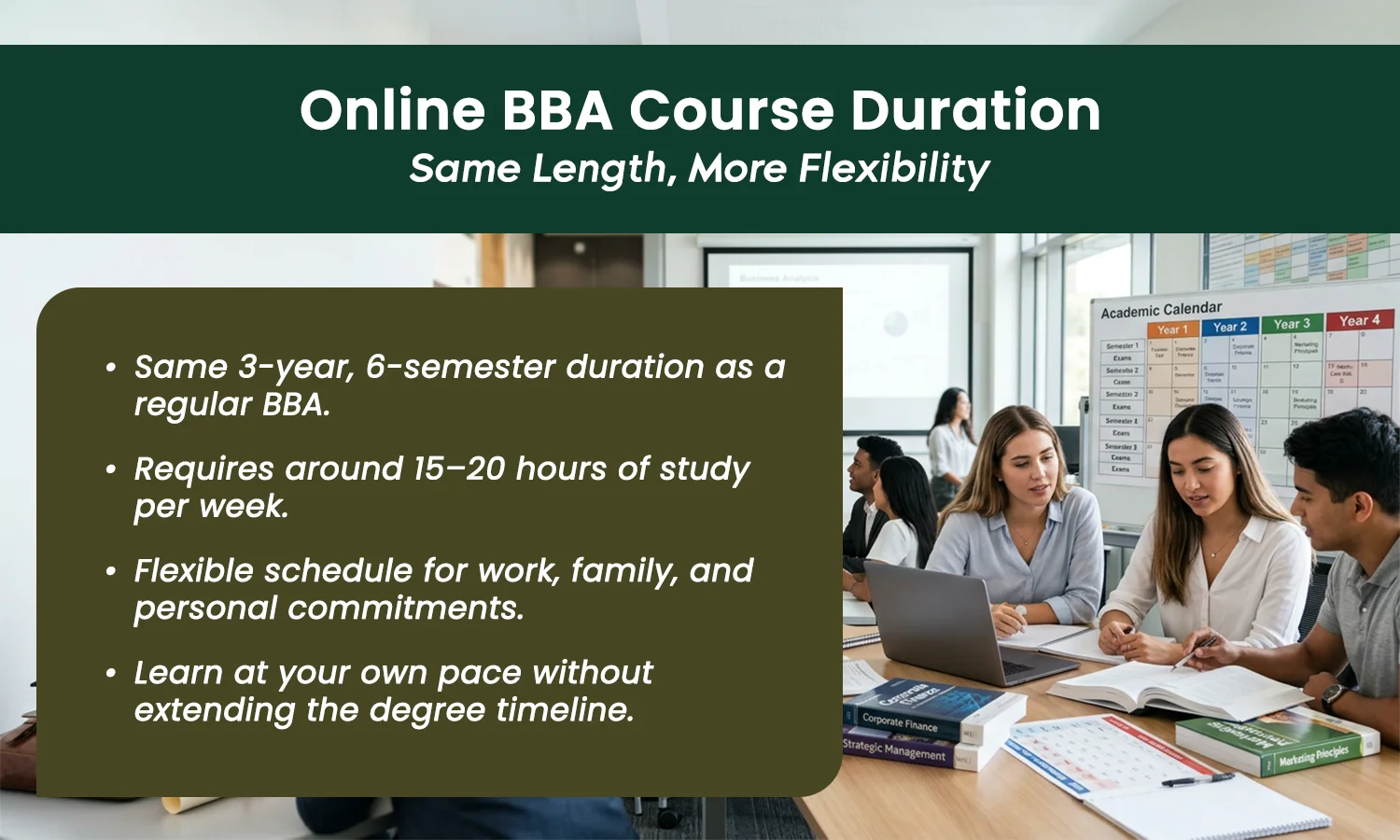
The online BBA course duration is identical to the campus version: three years, six semesters. The difference is how those six semesters fit into a learner’s life. Online programmes require 15 to 20 hours of weekly study, spread across live sessions, recorded lectures, reading, assignments and self-paced practice.
The timeline is not shorter — but it is significantly easier to combine with full-time employment, family responsibilities and other commitments. The total duration does not change; the flexibility around it does.
BBA Digital Marketing Course Duration and Other Specialisations
The BBA digital marketing course duration follows the standard three-year programme — specialisation does not extend the timeline. The same applies to BBA in Business Analytics, BBA in Finance, BBA in HR, BBA in International Business and BBA in Marketing. Specialisation typically begins in Year 3 with electives that replace generic ones in the standard curriculum, so the BBA course duration remains constant across all tracks.
Can You Finish A BBA Faster?
The honest answer is no — not within the UGC regulatory framework. Programmes marketed as “1-year BBA” or “fast-track BBA” are usually either credit-transfer pathways for learners who already hold a diploma (so they enter directly at Year 2 or Year 3 equivalence), or non-degree certificate programmes that do not carry the BBA parchment. The standard three-year timeline is non-negotiable for the recognised degree. The flexibility NEP 2020 provides is not duration compression, but the ability to pause, exit and re-enter.
Planning Your Three Years Strategically
The BBA course duration of three years is best thought of as a strategic resource rather than a fixed obligation. The most effective learners use Year 1 to build conceptual foundations and explore specialisation interests through reading and short certifications. Year 2 becomes the year to secure an internship and lock in a specialisation track. Year 3 is for capstone work, portfolio building and active interviewing — by the final semester, well-prepared learners typically have two or three offers in hand.
The BBA course duration is the same for everyone; the difference between graduates is what they do with the 36 months between admission and graduation. Treat it as a structured runway, not a waiting period.
FAQs
Is BBA 3 years or 4 years?
Three years is standard. Four years applies only to BBA Honours / Honours with Research under NEP 2020.
What is the BBA course duration at Online SRM?
The Online SRM BBA course duration is three years, structured across six semesters and 120 credits, with 15–20 weekly study hours.
Can I take a break and resume?
Yes — NEP 2020’s multiple-entry-exit framework, combined with Academic Bank of Credits, allows learners to pause and resume their degree.