
Summary
The BBA subjects taught in 2026 are designed to build business knowledge progressively through management, finance, marketing, analytics, economics and entrepreneurship. While the exact syllabus varies by institution, most programmes follow a structured path that prepares students for specialised careers, higher education and rapidly evolving business environments.
BBA subjects are designed to build business literacy in three layers — core fundamentals in Year 1, functional depth in Year 2, and specialisation electives in Year 3. Across the three years, learners study between 30 and 40 BBA course subjects covering accounting, marketing, economics, organisational behaviour, business law, operations, strategy, analytics and entrepreneurship. This guide lays out the complete BBA subjects list, semester by semester and specialisation by specialisation, so you know exactly what to expect.
How Many Subjects In BBA?
The standard answer to “how many subjects in BBA” is 30 to 40 across the three-year programme, spread across six semesters with five to seven subjects each. The total credit weight is approximately 120 credits, in line with NEP 2020 guidelines for undergraduate programmes. The exact subject count varies slightly between institutions, but the subjects of BBA — the underlying body of knowledge — is remarkably consistent: a common foundation followed by specialisation choice.
BBA Course Subjects — The Core Subjects List
The core BBA subjects list across institutions includes:
- ➤ Principles of Management — frameworks for planning, organising, leading and controlling
- ➤ Financial Accounting — recording, classifying and reporting business transactions
- ➤ Business Communication — written, verbal and presentation communication for the workplace
- ➤ Managerial / Microeconomics — demand, supply, pricing, market structures
- ➤ Business Mathematics and Statistics — quantitative foundations for business decisions
- ➤ Organisational Behaviour — individual, group and organisational dynamics
- ➤ Business Law — contracts, companies, consumer and digital business law
- ➤ Marketing Management — segmentation, targeting, positioning, 4Ps, customer journey
- ➤ Human Resource Management — talent acquisition, performance, learning and engagement
- ➤ Operations Management — process design, capacity, quality, supply chain
- ➤ Cost and Management Accounting — costing, budgeting, variance, decision support
- ➤ Strategic Management — competitive strategy, corporate strategy, execution
- ➤ Research Methodology — research design, data collection, analysis, reporting
- ➤ Entrepreneurship — opportunity recognition, venture design, founding teams
BBA Subjects In Degree (Year-Wise Breakdown)
The BBA subjects in degree programmes are typically distributed as follows:
| Year | Subjects of BBA |
|---|---|
|
Year 1 (Sem 1 + 2) |
Principles of Management, Financial Accounting, Business Communication, Managerial Economics, Business Mathematics, Business Statistics, Organisational Behaviour, Business Law, Marketing Management (Intro), Environmental Studies, Information Technology / Office Tools |
|
Year 2 (Sem 3 + 4)
|
Operations Management, Cost and Management Accounting, Human Resource Management, E-Commerce, Indian Financial System, Macroeconomics, Strategic Management (Intro), Research Methodology, Quantitative Techniques, Soft Skills, Taxation
|
|
Year 3 (Sem 5 + 6)
|
Specialisation electives, Advanced Strategic Management, Entrepreneurship, Internship, Capstone Project
|
BBA Subjects After 12th — What To Expect In Year 1
For learners new to the discipline, the BBA subjects after 12th in Year 1 are deliberately accessible. Principles of Management and Marketing Management introduce business vocabulary; Financial Accounting and Business Mathematics build numeracy; Business Communication and Organisational Behaviour develop soft skills. Even without a Commerce background, the Year 1 subjects in BBA are designed to bring all streams — Science, Arts and Commerce — to a shared baseline.
BBA Specialisation Subjects
BBA Marketing Subjects
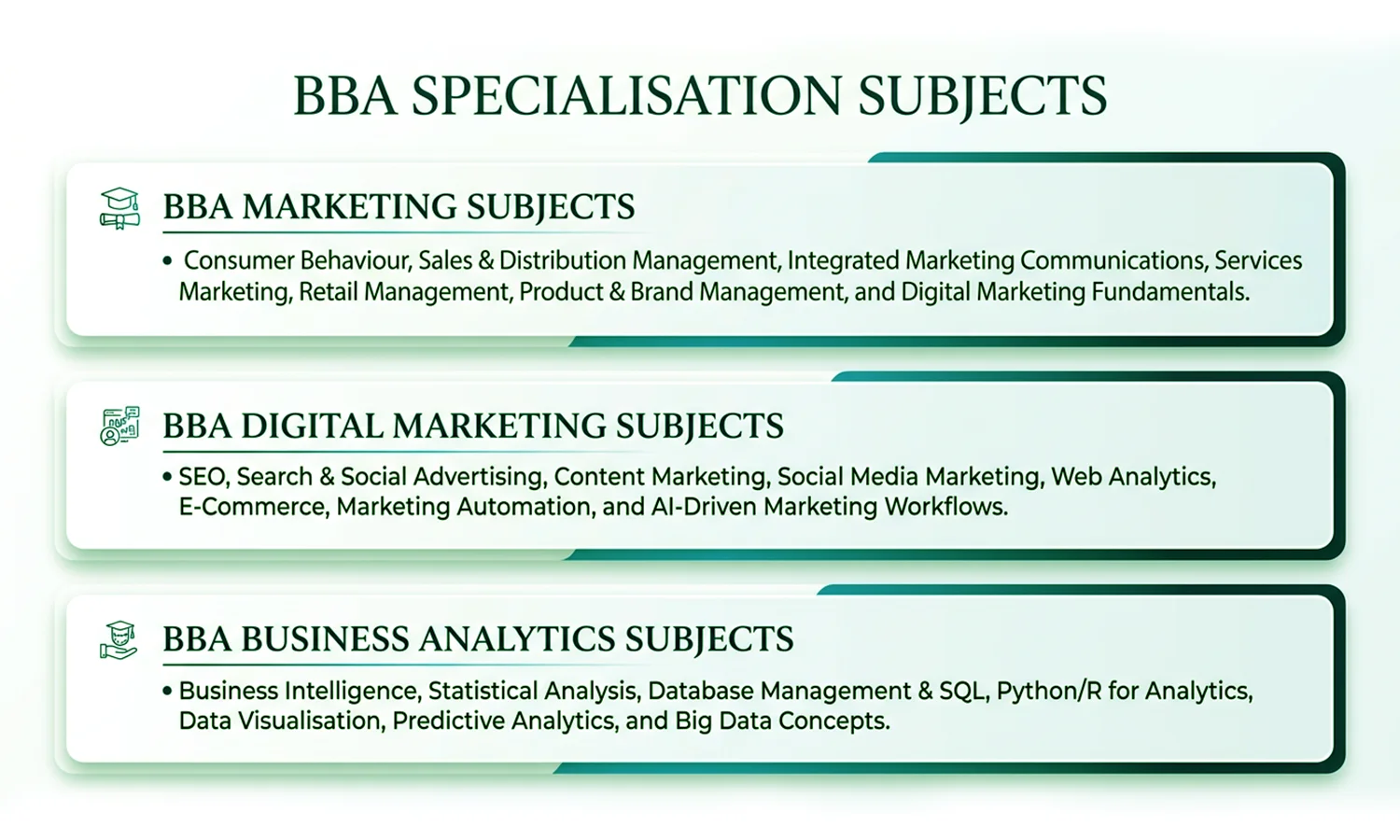
BBA marketing subjects (or BBA in marketing subjects) typically include Consumer Behaviour, Sales and Distribution Management, Integrated Marketing Communications, Services Marketing, Retail Management, Product and Brand Management, and Digital Marketing Fundamentals.
BBA Digital Marketing Subjects
BBA digital marketing subjects cover Search Engine Optimisation, Search and Social Advertising, Content Marketing and Strategy, Social Media Marketing, Web Analytics, E-Commerce, Marketing Automation and the increasingly important AI-driven Marketing Workflows.
BBA Business Analytics Subjects
BBA business analytics subjects include Business Intelligence Fundamentals, Statistical Analysis for Business, Database Management and SQL, Python or R for Analytics, Data Visualisation with Tableau and Power BI, Predictive Analytics, and Big Data Concepts.
Elective BBA Degree Subjects
Beyond core and specialisation, most institutions offer elective BBA degree subjects in Banking and Insurance, Logistics and Supply Chain, Retail Management, Hospital Management, Family Business and International Business — allowing learners to layer a second functional interest on top of their main specialisation.
How BBA Subjects Map To Career Roles
The most useful way to read a BBA subjects list is not by year, but by destination. Financial Accounting and Cost Accounting map onto finance, banking and corporate-treasury roles. Marketing Management, Consumer Behaviour and Sales Management map onto brand, growth and sales roles. Operations Management and Supply Chain electives map onto e-commerce, manufacturing and logistics roles.
HRM and Organisational Behaviour map onto talent acquisition, learning and development, and HR business partner tracks. Business Statistics, Research Methodology and analytics electives map onto data, business intelligence and consulting roles. Understanding this mapping early — ideally by Year 2 — lets learners pick electives strategically rather than reactively, and build a portfolio of project work aligned to a chosen destination.
Recommended Reading And Resources For BBA Subjects
A working list of recommended books across core BBA subjects: Principles of Management (Stephen P. Robbins); Financial Accounting (Narayanaswamy or Horngren); Managerial Economics (Dominick Salvatore); Marketing Management (Philip Kotler); Organisational Behaviour (Stephen P. Robbins); Operations Management (Russell and Taylor); Business Statistics (S.P. Gupta or Levin); Strategic Management (Hill, Schilling); Entrepreneurship (Steve Blank, Eric Ries).
For digital and analytics tracks, supplement textbooks with Google Skillshop courses, Microsoft Learn modules, and free Coursera content from Wharton, Michigan and Northwestern. Across all subjects in BBA programmes, weekly engagement with a quality business publication compounds learning more than any single textbook.
FAQs
How many subjects are in BBA total?
30 to 40 across the three-year programme, distributed over six semesters.
Is Mathematics one of the BBA subjects?
Yes — Business Mathematics is typically a Year-1 subject, but the level is foundational, not advanced.
Are BBA subjects difficult?
BBA subjects are application-focused rather than abstractly theoretical. Consistent weekly engagement is more important than prior background.